

VaeZip is the simple and efficient way to store latent tensors. It brings in low-bit quantization codecs, built around PyTorch and safetensors and exploits how VAEs store there latents.
-
The codecs were selected from the results of the LatentStorageBenchmark, which compares many latent storage schemes by reconstruction, fidelity, compression and I/O latency.
-
The impact on pretraining of the flow matching T2I DiT was measured in VaeZipTrainBench.
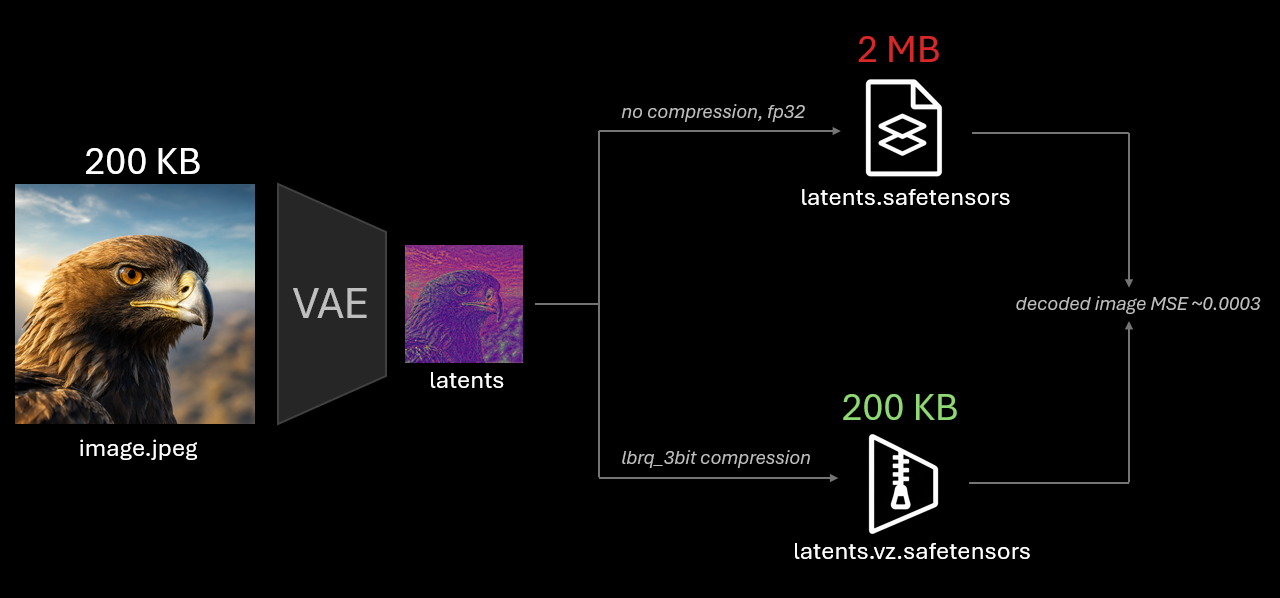
10x file size reduction with almost no quality loss. reproduce these results.
Use cases:
- Storage of large-scale encoded datasets for pretraining.
- Network transfer of latents in efficient inference pipelines, where VAE and generative transformer/VLM are on different nodes.
- Pipeline parallelism: Transfer activations/latents between pipeline stages over slow interconnects (PCIe, Ethernet, cross-datacenter).
pip install vaezipRequires Python 3.10+ and PyTorch 2.2+. Install PyTorch for your platform first if you need a specific build.
import torch
import vaezip

latents = torch.randn([4, 32, 128, 128], device="cuda")

vaezip.save_tensor(latents, "latents.vz.safetensors", codec="lbrq_4bit")
restored = vaezip.load_tensor("latents.vz.safetensors", device="cuda")
The codec config is stored in the file, so load_tensor() needs no codec.
Several tensors, each with its own codec, go to one file as a dict of EncodedTensor:
from vaezip.codecs import AutoCodec

tensor_a = torch.randn([4, 32, 128, 128])
tensor_b = torch.randn([4, 64, 256])
codec_b = AutoCodec.from_config("brq_8bit", block_size=(4,))

batch_dict = {
    "tensor_a": vaezip.encode(tensor_a, codec="lbrq_3bit"),
    "tensor_b": vaezip.encode(tensor_b, codec=codec_b),
}
vaezip.save(batch_dict, "batch_dict.vz.safetensors")

batch_dict = vaezip.load("batch_dict.vz.safetensors")
tensor_a = batch_dict["tensor_a"].decode(device="cuda")Codec is a compression algorithm configured at construction.
encode() returns an EncodedTensor, decode() returns a float32 tensor of the original shape
(or another floating dtype via decode(encoded, dtype=...)).
from vaezip.codecs import BlockRangeQuantCodec

codec = BlockRangeQuantCodec(
    value_bits=4, range_bits=4, channel_dim=1, block_size=(8, 8)
)
encoded = codec.encode(latents)
restored = codec.decode(encoded)
EncodedTensor holds named tensors plus string metadata with the codec config.
encoded.decode() restores the tensor with the codec from the metadata, or with an explicit codec=.
vaezip.encode() and vaezip.decode() are the same with codec shortcuts and configs.
Files hold a dict of EncodedTensor, vaezip.save() and vaezip.load() work with paths or bytes.
The format is .safetensors by default, .pth only with format="pth".
vaezip.save_tensor() and vaezip.load_tensor() are shortcuts for a file with a single tensor stored as "tensor".
Configs are diffusers-style JSON files and can be created from files, shortcut names or dicts. Keyword arguments override config values:
from vaezip.codecs import AutoCodec

codec.save_config("codec.json")
codec = AutoCodec.from_config("codec.json")
codec = AutoCodec.from_config("brq_8bit", block_size=(4, 4, 4))| Codec | Description |
|---|---|
CastCodec(cast_dtype) |
Cast to a floating dtype, e.g. torch.float16, torch.float8_e4m3fn. |
RangeQuantCodec(bits, channel_dim) |
Per-channel min/max normalization, bits-bit integers. |
BlockRangeQuantCodec(value_bits, range_bits, channel_dim, block_size) |
Min/max per block of a channel, value_bits inside the block range, block ranges stored with range_bits. |
LloydBlockRangeQuantCodec(..., lloyd_fast, cache_table) |
Same with Lloyd-Max level tables instead of uniform levels. |
The first tensor dimension is always the batch. Block codecs take one more dimension as the channel
(channel_dim, negative values count from the end) and treat the rest as spatial, block_size has one entry per spatial dimension:
# [B, C, H, W]
BlockRangeQuantCodec(value_bits=4, range_bits=4, channel_dim=1, block_size=(8, 8))
# [B, C, T, H, W], no temporal blocks
BlockRangeQuantCodec(value_bits=4, range_bits=4, channel_dim=1, block_size=(1, 8, 8))
# [B, T, C, H, W]
BlockRangeQuantCodec(value_bits=4, range_bits=4, channel_dim=2, block_size=(4, 8, 8))
Sizes that are not divisible by the block size are padded internally, decoded tensors keep the original shape. Low-bit values are bit-packed, so the size follows the number of bits. Quantization ranges are computed per sample, samples in a batch are encoded independently.
LloydBlockRangeQuantCodec always stores its level table in the encoded tensor.
cache_table=True fits the table once on the first batch and reuses it to speed up encoding,
codec.flush_cache() resets it.
| Name | Codec | Approx. bits per value |
|---|---|---|
cast_fp32 (default), cast_fp16, cast_bf16, cast_fp8_e4m3 |
CastCodec |
32, 16, 16, 8 |
rq_8bit, rq_6bit, rq_4bit |
RangeQuantCodec |
8, 6, 4 |
brq_8bit, brq_6bit, brq_5bit, brq_4bit, brq_3bit, brq_2bit |
BlockRangeQuantCodec |
8.1, 6.1, 5.1, 4.1, 3.1, 2.1 |
lbrq_8bit, lbrq_6bit, lbrq_5bit, lbrq_4bit, lbrq_3bit, lbrq_2bit |
LloydBlockRangeQuantCodec |
8.1, 6.1, 5.1, 4.1, 3.1, 2.1 |
The block shortcuts use value_bits from the name, range_bits=4, block_size=(8, 8) and channel_dim=1.
These settings are the points of the MSE Pareto front on FLUX.2 latents (benchmark run 1.2) closest to the target bit count.
vaezip.codecs.list_shortcuts() lists all names.
uv sync
uv run pytest
uv run ruff check . && uv run ruff format --check . && uv run mypy