


Xarxa (pronounced "sharsha"): "Network" in Catalan
xarxa is a standalone network stack designed for embedded, real-time systems.
It can work without std and without alloc.
The design goals are the following, in order of decreasing priority:
- No
unsafe. xarxa is exposed to the network and does complex packet parsing and manipulation. We want the guarantee that there is no memory safety vulnerabilities. - Well suited for small embedded systems. This means low RAM usage, small code size.
- High performance
- Scales up to larger systems with faster links, more sockets, larger buffers.
xarxa is a rewrite/refactor of smoltcp aiming to address some design shortcomings that I felt were holding smoltcp back. (where "I" is Dario Nieuwenhuis (@dirbaio), smoltcp maintainer since 2020 until starting this project).
xarxa is basically a "port" of smoltcp to the new design. Many parts are not affected and are ported mostly unmodified (e.g TCP, wire), others look more different (e.g. the main Stack) but are a 1:1 port of the original logic wherever possible.
There's two main design decisions where xarxa differs:
smoltcp manages buffers in the following way:
- The device implementation owns a buffer pool where it stores Ethernet frames that are being received/sent.
- The device hands out borrows of them to the network stack via the
TxToken/RxTokentraits. - All socket kinds (TCP, UDP, ICMP, raw) own one RX and one TX ring buffer.
- The network stack copies between the device buffers and the socket buffers.
This has a few implications:
- Zero-copy is impossible. You must do one copy between device and socket buffers.
- Multi-interface is very hard to implement. (smoltcp is currently single-interface).
TxToken/RxTokenmake theDevicetrait notdyn-compatible.- The "receive gives you a
TxTokento send the reply" trick doesn't work anymore because the reply to a packet may need to go out another interface.
- It's very memory-inefficient.
- You need to pay at least 2x MTU (1500*2 = 3kb) of RAM for each UDP/raw socket you create. This is why smoltcp implements DNS and DHCP sockets as dedicated
DnsSocketandDhcpSockettypes instead of building them on top of UDP and raw sockets. This is not very elegant. - For multi-interface you need dedicated pools per interface.
- You need to pay at least 2x MTU (1500*2 = 3kb) of RAM for each UDP/raw socket you create. This is why smoltcp implements DNS and DHCP sockets as dedicated
Instead, xarxa has a single global packet pool. It passes owned handles around, so any part of the stack (device, sockets, everything else) can easily own packets. This unlocks many improvements:
- Multi-interface becomes trivial.
- Zero-copy is now possible. An interface writes a received packet into a buffer, which then goes through dispatch, gets queued in a socket, and then gets handed to the user. Same for egress.
- It allows fixing "structurally unfixable" bugs like the tx queue clog when sending to multiple IPs from a single socket.
smoltcp defines plain old Rust structs such as IpRepr, UdpRepr. At ingress, it reads the packet wire bytes and deserializes it into reprs. At egress, the reprs are serialized to bytes. The entire core works with these repr structs.
xarxa makes the core work with the packet bytes directly instead. Why?
- It's faster. Serializing and deserializing is work that doesn't add value. It just loads from RAM in one format and writes in another format. The compiler is not good at optimizing it out.
- Smaller code size, for the same reason.
- Allows for actually-raw raw sockets. smoltcp raw sockets drop fields from the IP header because packets get deserialized and reserialized. The repr structs are intentionally incomplete, they don't contain fields that the stack doesn't look at. Adding them would hurt code size and perf. I've attempted refactors to avoid this reserialization in the past but they ended up too invasive and ugly since you basically need to add a way to thread raw bytes through the whole stack.
xarxa is faster and smaller than smoltcp, and roughly matches lwIP.
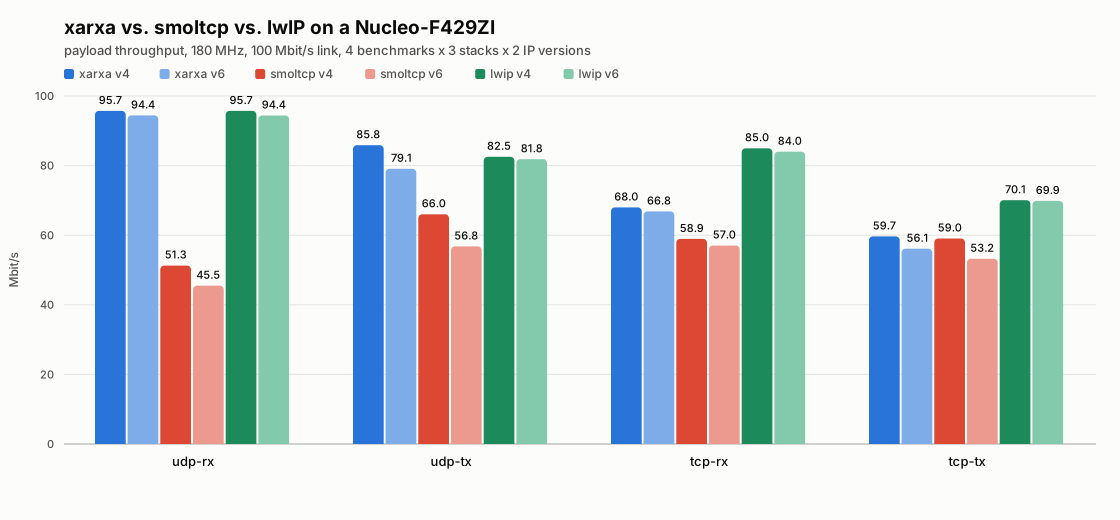
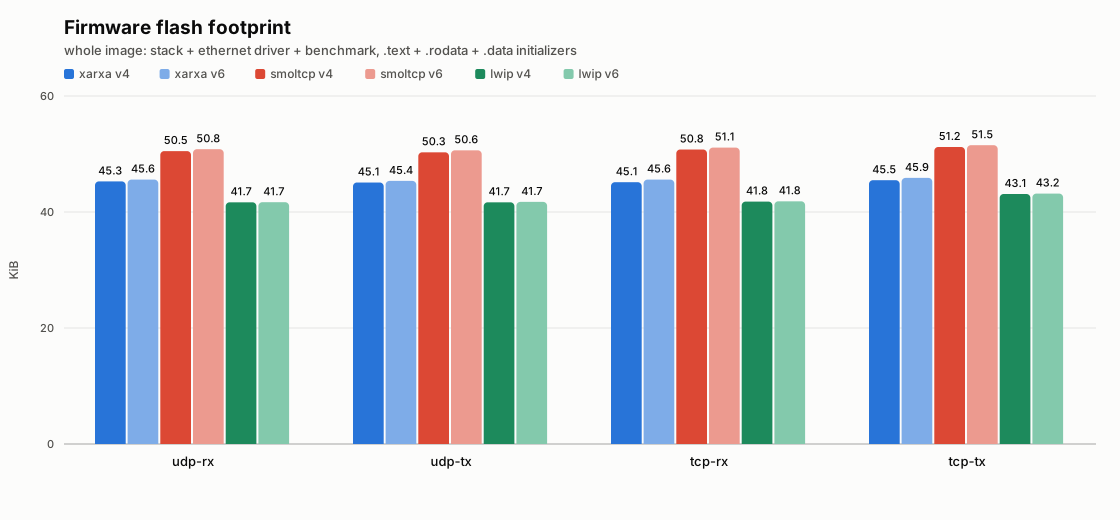
Benchmark source code is available here.
- Multiple interface support
- Add/remove interfaces dynamically to the network stack.
- Each interface has its own configuration (like IP addresses)
- A route table chooses which interface to use on egress.
- Mixing mediums in is supported.
- The driver reports its hardware address and link state to the stack.
- Ethernet interface medium (feature
medium-ethernet)- Does IPv4 ARP, IPv6 NDISC.
- Neighbor cache with expiry, renewal on use.
- The network stack buffers egress packets pending network resolution. Unreachable neighbors don't clog sockets.
- Pure IP interface medium (feature
medium-ip) - IEEE 802.15.4 interface medium (feature
medium-ieee802154)- 6LoWPAN header compression: IPHC for the IPv6 header, NHC for UDP and extension headers, done in place in the packet buffer.
- Address contexts for decompression.
- NDISC over 802.15.4, link-local address from the extended address.
- 6LoWPAN fragmentation (feature
sixlowpan-fragmentation) - 6LoWPAN reassembly (feature
sixlowpan-reassembly)
- IPv4 (feature
ipv4)- DHCP client (feature
dhcpv4)- Raw access to all lease options by option number. (feature
dhcpv4-options) - Sends the stack's hostname to the server, if set. (feature
hostname)
- Raw access to all lease options by option number. (feature
- DHCP server (feature
dhcpv4-server)- Turned on per interface, hands out leases from a configured pool with gateway and DNS options.
- API to inspect and remove leases.
- Fragmentation (feature
ipv4-fragmentation) - Reassembly (feature
ipv4-reassembly)
- DHCP client (feature
- IPv6 (feature
ipv6)- Link-local address automatically derived from the MAC address (EUI-64).
- SLAAC: addresses and default routes from router advertisements, with lifetimes. (feature
slaac)
- ICMP
- Automatically replies to pings. (feature
icmp-ping-reply) - Incoming ICMP errors are routed to the socket that caused them. (feature
icmp-errors)
- Automatically replies to pings. (feature
- UDP sockets (feature
udp)- zero-copy on both TX and RX
- Supports all binding modes Linux supports, including unconnected (receives from any IP) and connected sockets (receives from one fixed remote IP+port).
- Raw sockets
- zero-copy on both TX and RX
- Ethernet-layer raw sockets transmit/receive raw Ethernet frames. No routing. (feature
raw-ethernet) - IP-layer raw sockets transmit/receive raw IP packets. The stack handles routing same as other socket types. (feature
raw-ip) - IP headers are byte-copied instead of parsed+re-emitted, so all fields and options are kept, even those unsupported by xarxa.
- TCP sockets (feature
tcp)- Full TCP implementation
- TCP listeners implement an accept queue. Buffers are not allocated until you
accept()a connection. (featuretcp-listener) - Window scaling
- Configurable keepalive.
- RTT estimation automatically tunes retransmission timeout
- Compile time selection of CUBIC, Reno or no congestion control.
- Nagle's algorithm (defaults to enabled, can be turned off)
- Delayed ACK (defaults to enabled, can be turned off)
- Zero-window probes
- TCP Timestamps (feature
tcp-timestamps) - TCP SACK, sending ranges only (feature
tcp-sack)
- DNS client (feature
dns)- Multiple servers, retransmission with backoff.
- Multicast DNS for
.localnames (featuremdns)
- IP multicast (feature
multicast)- Join and leave multicast groups per interface.
- IGMPv1/IGMPv2 (IPv4) and MLDv2 (IPv6): membership is reported on join and leave, and in response to router queries.
- The IPv6 solicited-node groups of the interface's addresses are joined automatically.
- The multicast hardware addresses the stack listens on are reported to the driver, for devices that filter multicast in hardware.
- Bind sockets to an interface, like Linux's
SO_BINDTODEVICE. (featureiface-bind) - Packet metadata
- Support for hardware timestamping on both RX and TX. Allows implementing protocols like PTP, NTP. (feature
packetmeta-timestamp) - Opaque ID for correlating packets through the stack. (feature
packetmeta-id)
- Support for hardware timestamping on both RX and TX. Allows implementing protocols like PTP, NTP. (feature
- Checksum offload: interfaces report which checksums they can validate/calculate and the stack skips them.
All of the below is planned. Please open an issue or reach out on the Matrix chat if you want to work on one of these so we don't duplicate work.
- Acting on link state: skipping down interfaces on egress routing, restarting DHCP/SLAAC on link-up.
- IPv6 DAD (duplicate address detection)
- IPv6 RDNSS (DNS servers from router advertisements)
- an equivalent to smoltcp's
any_ip - IPv6 fragmentation and reassembly
- TCP segmentation offload
- TCP SACK, acting on ranges received from the peer.
- Store sockets on a hashmap so packet dispatch is O(1) instead of O(n). (would be optional with a Cargo feature, it's only worth if you have thousands of sockets, i.e. not on embedded)
- Maybe multithreading. Would require per-socket mutexes etc. (again, optional, would require std)
xarxa is distributed under the terms of 0-clause BSD license.
See LICENSE-0BSD for details.