

I design and build AI systems with a focus on real-world constraints — not just benchmark performance.
My work focuses on making modern AI systems — particularly 3D, vision and language models — reliable, measurable and usable in high-stakes domains like healthcare.
My background sits at the intersection of machine learning, computer vision, and healthcare AI. I've shipped production systems at BMW Group (MINI Oxford), where I worked on everything from robotic vision pipelines to NLP-driven OCR tools. I've since completed an MSc in Artificial Intelligence at Loughborough University, where my dissertation asked a question I think medical AI needs to ask more often: when a model gives an answer, how do we know we can trust it?
- Reliable AI for healthcare: evaluation beyond a single score (consistency, robustness, failure modes)
- 3D deep learning: point clouds, meshes and multi-view representations of anatomy (intra-oral scans, dental models)
- Medical imaging: classification, localisation and interpretability (Grad-CAM)
- LLMs for clinical question answering: parameter-efficient fine-tuning (LoRA, prefix tuning) and trustworthy evaluation
- Research to real systems: reproducible, tested pipelines and real-time perception on embedded hardware
- Reliable 3D Tooth Completion - building on my MSc dissertation: generative models that rebuild incomplete intra-oral scans, evaluated for both accuracy and consistency. Next: making the model robust to how a tooth is oriented, and testing results across multiple training seeds
- Biomedical QA with small LLMs - rebuilding my BSc dissertation as a reproducible package, correcting its evaluation and re-running the method comparison.
- Looking for my next role — in medical AI research or AI engineering, where careful evaluation matters
🔗 Repository • 📊 Results • 🏷️ Dissertation version
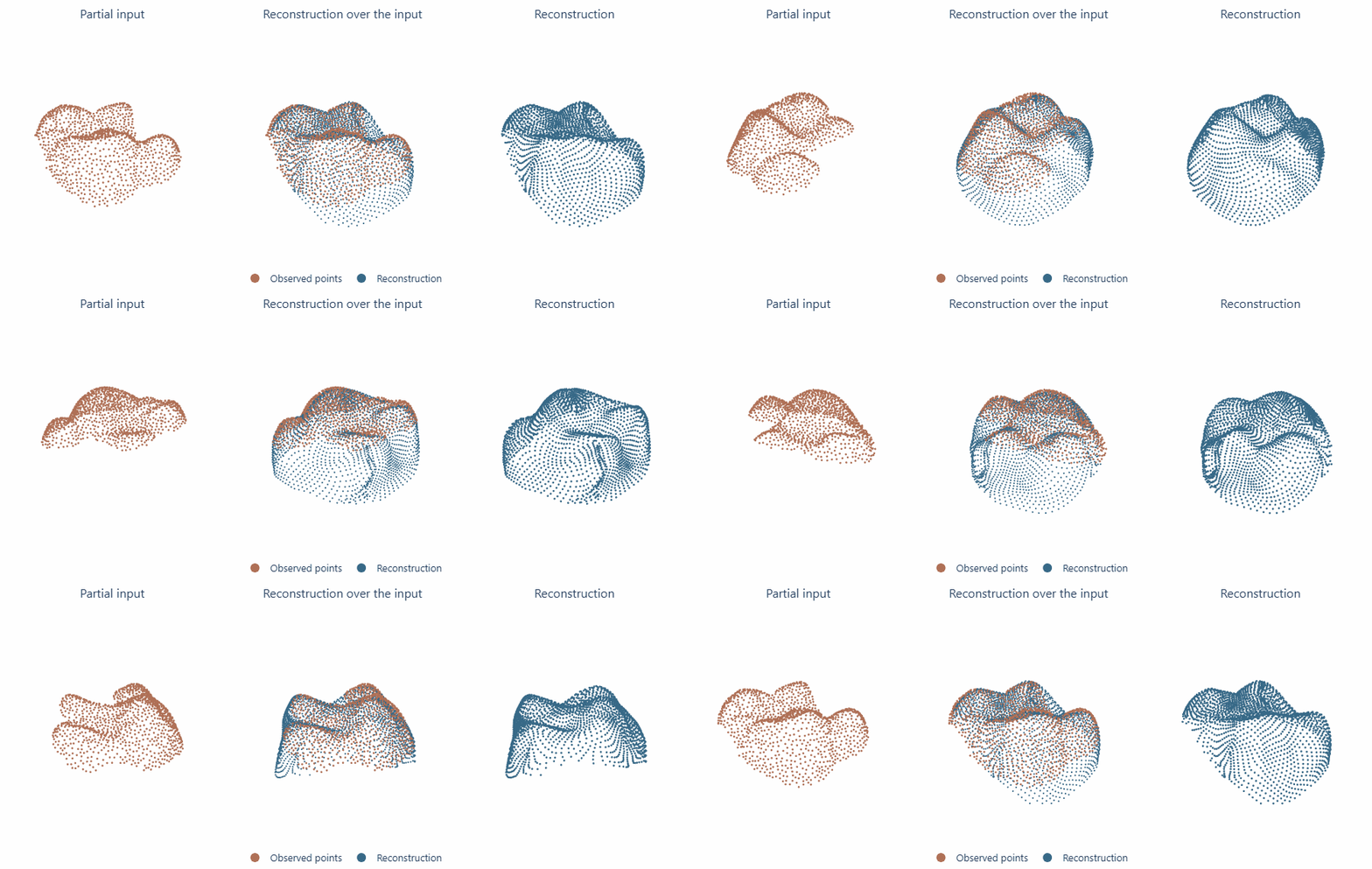
Intra-oral 3D scans are often incomplete: the scanner cannot see behind neighbouring teeth, the patient moves, braces get in the way. This project trains a β-variational autoencoder on point clouds of real teeth (Teeth3DS+) to rebuild the missing geometry, and evaluates it on two questions: how accurately it completes a tooth, and how consistently, since a generative model can produce many plausible completions of the same input, and in clinical use there is no complete tooth to check against. The work spans a full pipeline from 300 clinical jaw scans to 4,038 segmented teeth and 32,304 controlled partial teeth, an architecture study, and per-tooth evaluation with four metrics, including region-specific errors and a stochastic consistency error defined in the project. The research code was then rebuilt into a tested Python package that reproduces every reported result exactly.
- Full 3D pipeline on clinical data — jaw scans → segmented teeth → normalised 2,048-point clouds → plane-cut and connected-patch partial teeth, seeded and reproducible
- Architecture study — 4 point-cloud encoders (PointNet, T-Net PointNet, PointNet++, DGCNN) × 3 decoders (MLP, FoldingNet, AtlasNet) and an 8-value KL-weight ablation; DGCNN + FoldingNet is 14% more accurate than an MLP decoder with 91% fewer parameters
- Evaluation beyond one number — Chamfer distance, missing-region and observed-region errors, and stochastic consistency, broken down per tooth position on a dental chart
- Key finding — the model's consistency is only weakly correlated with its accuracy (r ≈ 0.2–0.3): a model agreeing with itself is not evidence that it is right
- Verified, engineered rewrite — all 16 trained models reproduce the original outputs; 98 automated tests; CPU-safe local development with GPU training on Colab
Why it matters In clinical use there is no complete tooth to compare a completion against, so a model's reliability has to be measured, not assumed. This project shows that consistency can flag uncertainty but cannot certify accuracy, so trustworthy 3D completion needs both to be reported.
Python PyTorch 3D Point Clouds Generative Models β-VAE DGCNN FoldingNet Medical AI Dental Imaging Reliability Reproducibility
🔗 Repository • 📄 Report • 🖼️ Grad-CAM example
Deep learning pipeline for multi-class classification and visual localisation of pulmonary disease from chest X-rays (Healthy, Pneumonia, COVID-19). Built around a controlled transfer learning framework using an ImageNet-pretrained Xception backbone, the project prioritises clinically meaningful evaluation (recall, macro-F1) under class imbalance and subtle inter-class overlap. The system combines robust preprocessing, weighted optimisation, and Grad-CAM interpretability to produce both predictions and spatial insight into model decision-making.
- Transfer learning with Xception backbone + lightweight classification head, balancing representational power with overfitting control
- Structured experimentation across learning rate, optimiser choice, and layer unfreezing strategies, ensuring causal performance attribution
- Class imbalance handled via weighted loss, avoiding synthetic data risks in sensitive medical domains
- Evaluation beyond accuracy: macro F1 (~0.99), per-class recall, precision-recall curves, calibration analysis, confusion matrix
- Integrated Grad-CAM visualisation for localisation, highlighting clinically relevant lung regions influencing predictions
- Dataset: ~15k chest X-ray images, stratified 70/15/15 split, minimal augmentation to preserve diagnostic fidelity
Why it matters Reliable automated screening tools must prioritise missed diagnosis risk (false negatives) over raw accuracy. This project reflects real clinical constraints—imbalanced data, ambiguous imaging, and the need for interpretability—while demonstrating how careful transfer learning design can produce robust, explainable models.
Python TensorFlow Keras Deep Learning Computer Vision Medical Imaging Transfer Learning Xception Grad-CAM Model Evaluation
🦷🧠 Adapting AlexNet for 3D Object Classification, Using a View-Based Approach for Orthodontics Classification
🔗 Repository • 📄 Notebook • 🌐 HTML View
An end-to-end deep learning pipeline for 3D object classification, transforming raw 3D models into a structured multi-view dataset and training a CNN to distinguish between upper and lower jaw structures. The system begins with a preprocessing stage that converts 3D
.objfiles into multiple 2D projections captured from different viewpoints, forming a multi-view representation that preserves spatial information while enabling efficient learning. These views are aggregated into structured tensors and passed through a convolutional neural network adapted to process non-standard inputs, learning features across perspectives rather than single images. The project emphasises pipeline design under real-world constraints, demonstrating how data representation, model architecture, and training strategy interact to produce a robust classification system without relying on bundled datasets.
- 3D → multi-view dataset generation — Converts 3D objects into structured 2D projections for CNN compatibility
- Multi-view representation learning — Captures spatial features across perspectives rather than single-image inputs
- CNN-based classification — Adapted architecture processes multi-view tensors for anatomical classification
- End-to-end pipeline design — Integrates data generation, preprocessing, and training into a unified workflow
- Reproducible notebook implementation — Fully contained
.ipynbwith HTML export for accessible review - Constraint-aware engineering — Designed without bundled datasets, focusing on methodology and adaptability
Why it matters 3D data is inherently complex and difficult to process efficiently. This project demonstrates how transforming 3D structures into multi-view representations enables the use of standard deep learning techniques while preserving spatial information. By integrating dataset generation with model training, it highlights the importance of representation design and pipeline architecture in building effective AI systems under practical constraints.
Python PyTorch 3D Data Computer Vision Deep Learning Multi-View Learning Medical AI
🔗 Repository • 📄 Report • 🎥 Demo
A real-time, closed-loop human-following system built on embedded hardware, integrating YOLO-based detection, DeepSORT tracking, and RGB-D depth estimation. The system enforces a strict safety constraint: no verified perception signal results in no motor output. Detections are passed into a Kalman-filter-based tracker with ReID embeddings to maintain identity through occlusions. The system prioritises the oldest confirmed track to prevent ID switching in multi-person environments. Depth estimation is performed via sparse RGB-D sampling within the target bounding box, with statistical outlier rejection. This produces stable lateral offset (X) and distance (Z) estimates, which feed into a PID controller with angular correction derived from
arctan(X/Z). The architecture evolved from a detection-only baseline that failed under crowding and occlusion. The final design separates perception and control, with strict inter-stage validation and fail-safe gating to ensure predictable degradation and safe operation.
- YOLO + DeepSORT pipeline — Real-time person detection with Kalman prediction and ReID-based identity tracking
- Occlusion robustness — Oldest-track selection and motion prediction maintain stable identity without ID switching
- RGB-D depth estimation — Sparse sampling with outlier rejection for reliable (X, Z) spatial estimation
- PID control system — Independent distance and angular control loops with deadband and smoothing for stability
- Embedded deployment — Optimised for real-time inference on Jetson/ARM hardware under strict latency constraints
- Systematic evaluation — Tested across multi-person scenes, occlusion events, and sensor noise; evaluated using ID switches, tracking stability, and RMS error
Why it matters Robust human-following in real-world conditions requires more than accurate models — it demands careful system design across perception, tracking, and control. This project demonstrates how architectural decisions and failure handling enable reliable behaviour in crowded, dynamic environments.
Python PyTorch Computer Vision Robotics YOLO DeepSORT RGB-D PID Control Embedded AI
🔗 Repository • 🏷️ Dissertation reproduction
Can a small open LLM be adapted cheaply to answer biomedical research questions? This project compares three ways of adapting Llama 3.2 3B Instruct to PubMedQA (prompt engineering, prefix tuning and LoRA on a 4-bit quantised model) against the untuned baseline, all on the same fixed 1,000-question test split with the same decoding settings. The original dissertation code was rebuilt into a tested Python package and its results reproduced. Reproducing it turned up 11 flaws in the original evaluation that could bias the comparison, so the method was then corrected and every method re-scored.
- Three adaptation methods, one base model: prompt search on the validation split; prefix tuning (20 virtual tokens); LoRA (rank 8, 0.07% of parameters) with QLoRA-style 4-bit quantisation
- Reproducible data pipeline: 211k PubMedQA rows → filtered, de-duplicated, balanced, stratified 80/10/10 splits that are byte-identical to the original run
- Custom evaluation framework: yes/no read from next-token probabilities (no LLM judge), plus NLI entailment, METEOR and BERTScore on the written explanation, format adherence, bootstrap confidence intervals and paired McNemar tests
- Reproduce, then correct: all four methods reproduced within agreed tolerances; flaws found along the way include a prompt chosen on test data, a required answer format the decoding settings made impossible, and a yes/no judge that was the model being evaluated
- Key finding: (fill in once the v2 results are verified)
Why it matters A comparison between models is only as good as the evaluation behind it. Small evaluation choices (decoding penalties, where a prompt is chosen, who judges the answer) can move results by several points, so they need to be checked as carefully as the models.
Python PyTorch Hugging Face PEFT LoRA Prefix Tuning QLoRA bitsandbytes LLMs Llama 3.2 PubMedQA NLP Evaluation Reproducibility
-
Synthetic Data in Medical Image Analysis: A Critical Evaluation → A map of how synthetic data is generated, integrated and evaluated in medical imaging, and a critique of two influential studies (Gao et al., 2023; Al Khalil et al., 2023)
→ Argues that performance gains alone cannot establish clinical validity: the same principle behind my 3D tooth completion work, which measures consistency alongside accuracy
→ 📄 Download as PDF • 📊 Summary slides
-
Artificial Intelligence and the Research and Reporting of Dental History → Explores the application of AI in analysing and structuring historical dental research data
- MSc Artificial Intelligence — Loughborough University (2026) — dissertation: Reliable 3D Tooth Completion
- BSc Artificial Intelligence and Computer Science — Loughborough University — 1st
- AI/ML Engineer — BMW Group (MINI Oxford Plant)
ML & AI


Languages


Deployment & Tooling


Domains
| Area | Experience |
|---|---|
| Medical AI | 3D tooth completion, chest X-ray classification & localisation, biomedical research question answering |
| 3D Deep Learning | Point clouds (PointNet, DGCNN), generative models (β-VAE), multi-view CNNs |
| Computer Vision | Object detection, tracking, segmentation, OCR, stereo vision |
| NLP | Transformers, RAG, document understanding, chatbots |
| Time Series | Forecasting, anomaly detection, sensor data |
| MLOps | Model serving, monitoring, fine-tuning workflows |
- Start from the real-world constraint, not the model
- Prefer simple, robust systems over complex, fragile ones
- Treat evaluation as seriously as modelling: a single score is not evidence of reliability
I'm looking for medical AI research and AI engineering roles, and I'm always open to research collaborations and interesting problems in healthcare AI.


