
| Package |    |
| Quality |     |
| Documentation |  |
| Code style |  |
| Downloads |   |
| Community |     |
See the equations of chemistry at work. chemistrykit is a Python toolkit for learning and teaching computational chemistry, from Arrhenius kinetics and oscillating reactions to Hückel aromaticity, Hartree-Fock, NMR multiplets and powder XRD. Every model is built from its first-principles formula, every simulation returns an inspectable result dataclass, every domain ships plotting helpers, and each domain's docs walk through the field's breakthroughs in historical order, each one linked to runnable code that reproduces it.
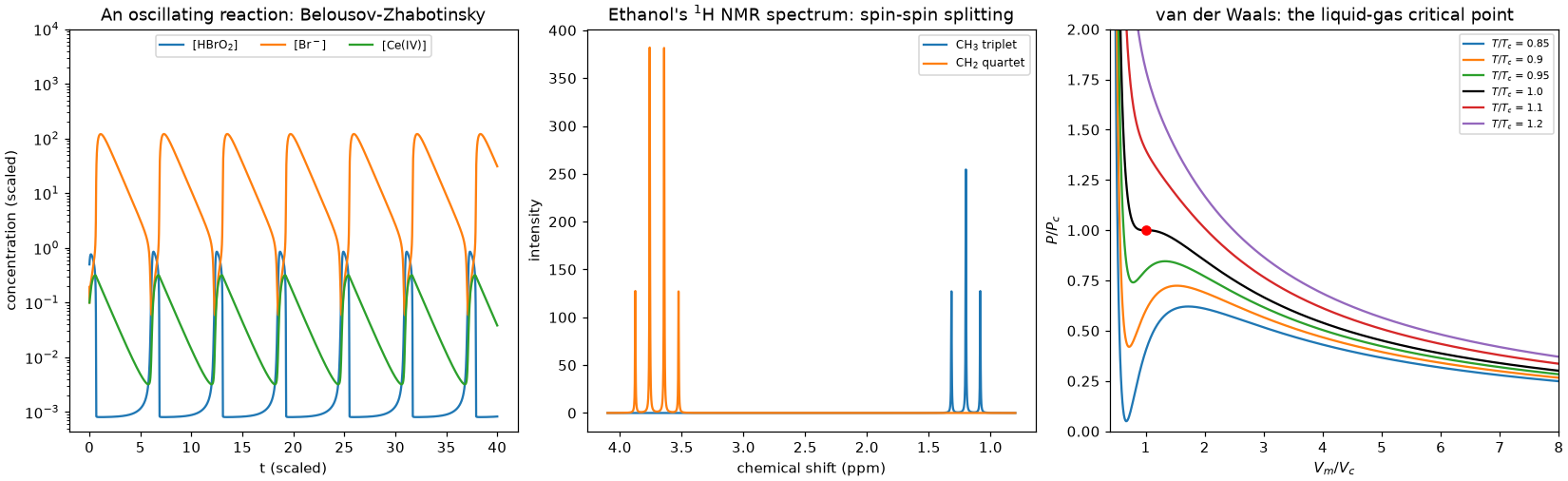
- For students: watch the Belousov-Zhabotinsky reaction oscillate, see where ethanol's triplet and quartet come from, find the ethanol-water azeotrope, all in a few lines each.
- For instructors: 14 domains, one consistent API, and over 200 gallery examples, each downloadable as a Python script or Jupyter notebook, ready to hand out as course material.
- Pure-numerical, built on numpy/scipy: no cheminformatics dependencies (no RDKit/ASE/PySCF/OpenMM); library routines under the hood, with algorithms hand-rolled only where the steps themselves are what you're learning (see Design).
chemistrykit is part of a family of packages -- physicskit, mathematicskit and chemistrykit -- that share the same architecture, API conventions, and history-driven documentation.
pip install chemistrykitThen import chemistrykit as ck. Runtime dependencies are numpy, scipy,
matplotlib, numba (which compiles the inner
loops of kinetics reaction networks, md pair forces, and the shared
integrators), plotly, sympy, and tqdm.
For development: pip install -e ".[dev]" (see CONTRIBUTING.md).
import chemistrykit as ck
from chemistrykit.kinetics.visualizers.kinetics_plots import plot_concentration_vs_time

# Closed-form first-order decay and its half-life
print(ck.kinetics.FirstOrder(k=0.1, C0=1.0).half_life())  # ln(2) / k = 6.93

# A general stoichiometric reaction network: A -> B -> C
network = ck.kinetics.StoichiometricNetwork.consecutive(k1=1.0, k2=0.3, A0=1.0)
result = network.integrate((0.0, 15.0), dt=1e-3, method="rk4")
B = result.concentration("B")
print(f"[B] peaks at t = {result.t[B.argmax()]:.2f}")  # ln(k1/k2) / (k1 - k2) = 1.72

plot_concentration_vs_time(result)Domain subpackages, each with runnable examples linked below:
-
chemistrykit.kinetics-- reaction kinetics: integrated rate laws and half-lives, the Arrhenius equation and activation-energy fitting, Michaelis-Menten enzyme kinetics with Lineweaver-Burk linearization and inhibition, a general stoichiometry-matrix reaction-network engine (parallel/consecutive/reversible/steady-state-approximation chains) integrated by numba-compiled right-hand sides onchemistrykit.integrators, the Brusselator and Oregonator (Belousov-Zhabotinsky) oscillating reaction networks, Gillespie stochastic simulation (hand-rolled), Lindemann-Hinshelwood unimolecular falloff, and Semenov chain-branching explosion limits for H2/O2.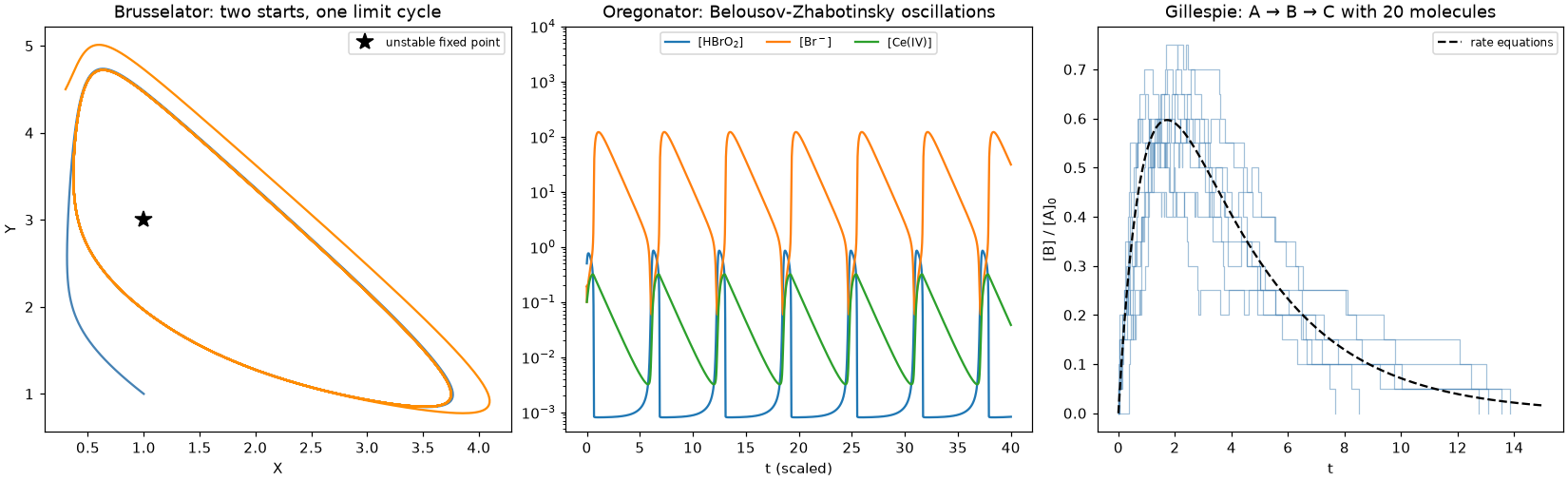
-
chemistrykit.thermo-- chemical thermodynamics: equations of state (ideal gas, van der Waals, Redlich-Kwong), Clausius-Clapeyron and Antoine vapor-pressure curves, reaction equilibrium (Kp/Kc, van't Hoff, and a Gibbs-energy-minimization equilibrium-composition solver viascipy.optimize.minimize), Raoult's/Henry's law mixtures with colligative properties, and Margules/Wilson/NRTL/UNIQUAC activity models for non-ideal vapor-liquid equilibrium and azeotropes (roots viascipy.optimize.brentq).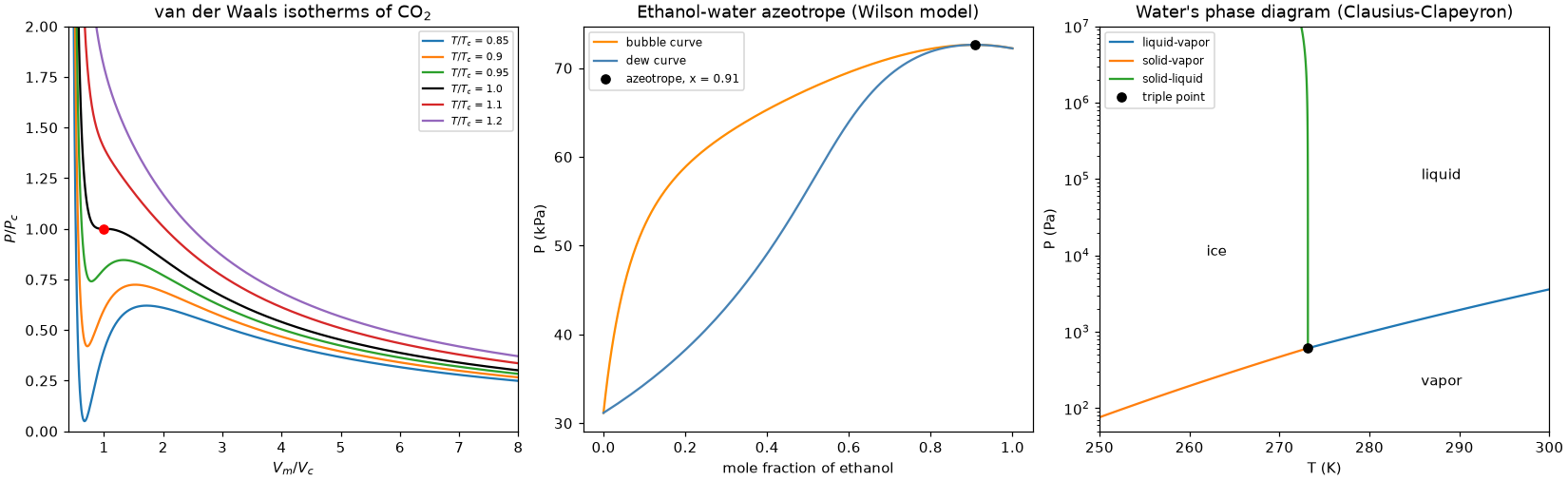
-
chemistrykit.solutions-- solution chemistry: pH/pOH and weak acid/base equilibria with Henderson-Hasselbalch buffers, acid-base titration curves, Ksp solubility equilibria and the common-ion effect, polyprotic and metal-ligand complexation speciation, and Debye-Huckel activity coefficients (equilibria solved withscipy.optimize.brentq).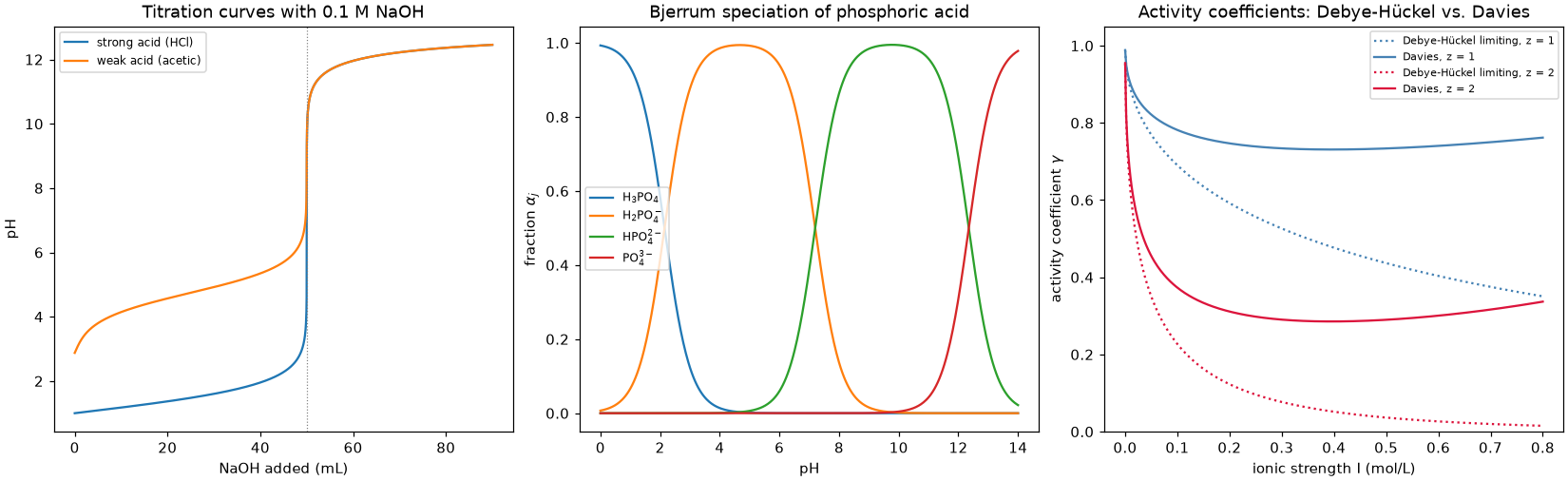
-
chemistrykit.md-- molecular dynamics and force fields: the Lennard-Jones fluid in reduced units (periodic boundary conditions, a Verlet neighbor list, pressure, g(r)), Morse/Buckingham/harmonic bonded potentials, velocity-rescaling/Nose-Hoover thermostats, mean-squared displacement and Green-Kubo diffusion, and XYZ trajectory export for VMD/OVITO (numba-compiled pair forces; integrators and thermostats hand-rolled, since they are the subject).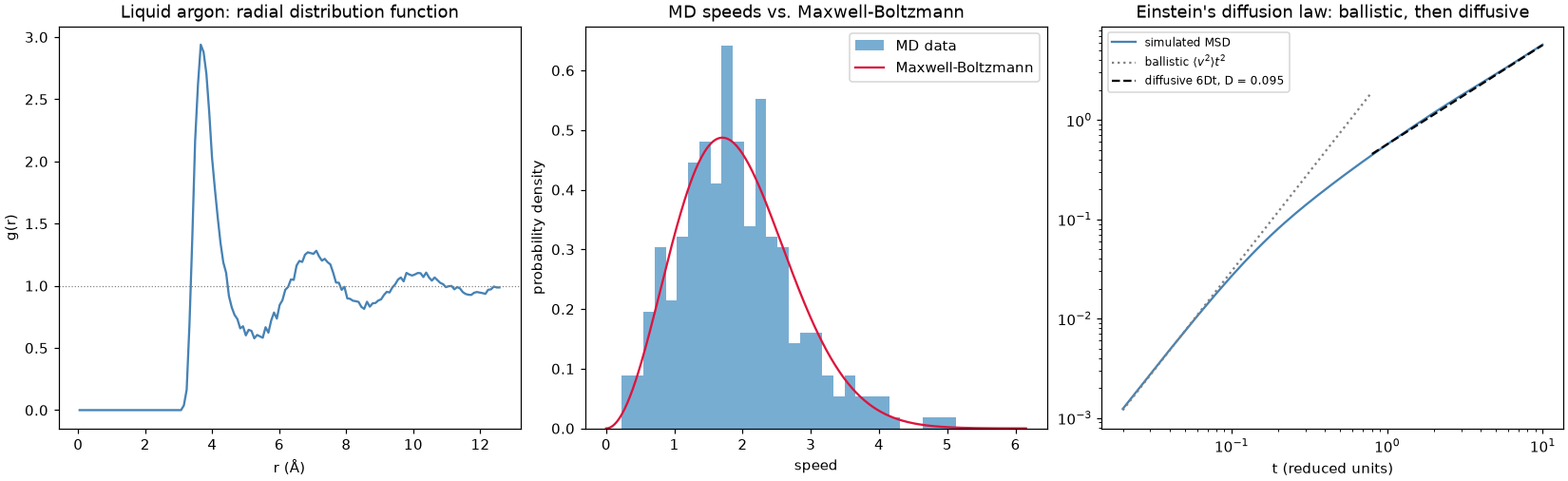
-
chemistrykit.statmech-- statistical mechanics of molecules: translational/rotational/vibrational partition functions and their thermodynamic functions, the Maxwell-Boltzmann speed distribution, Einstein and Debye heat capacities (Debye functions viascipy.integrate.quad), Onsager's exact 2D Ising solution (elliptic integrals viascipy.special), and a canonical-ensemble lattice-gas adsorption model.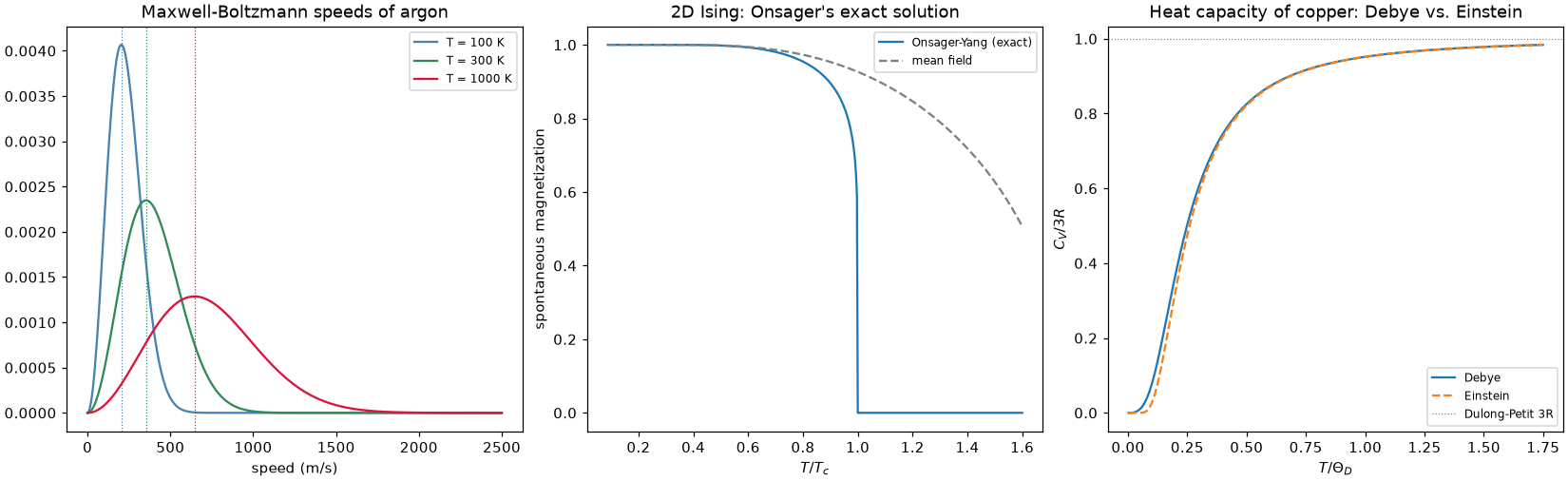
-
chemistrykit.quantum-- quantum chemistry: particle-in-a-box models (with the free-electron model of conjugated-dye color); the quantum harmonic oscillator vs. the exact Morse potential; the rigid rotor; hydrogen-like orbitals; Huckel molecular-orbital theory and its 4n+2 aromaticity rule; a minimal variational treatment of H2+; restricted Hartree-Fock SCF in an STO-3G basis for H2 and HeH+; and Rayleigh-Schrodinger perturbation theory for the anharmonic oscillator (eigenproblems viascipy.linalg.eigh, with the SCF loop hand-rolled).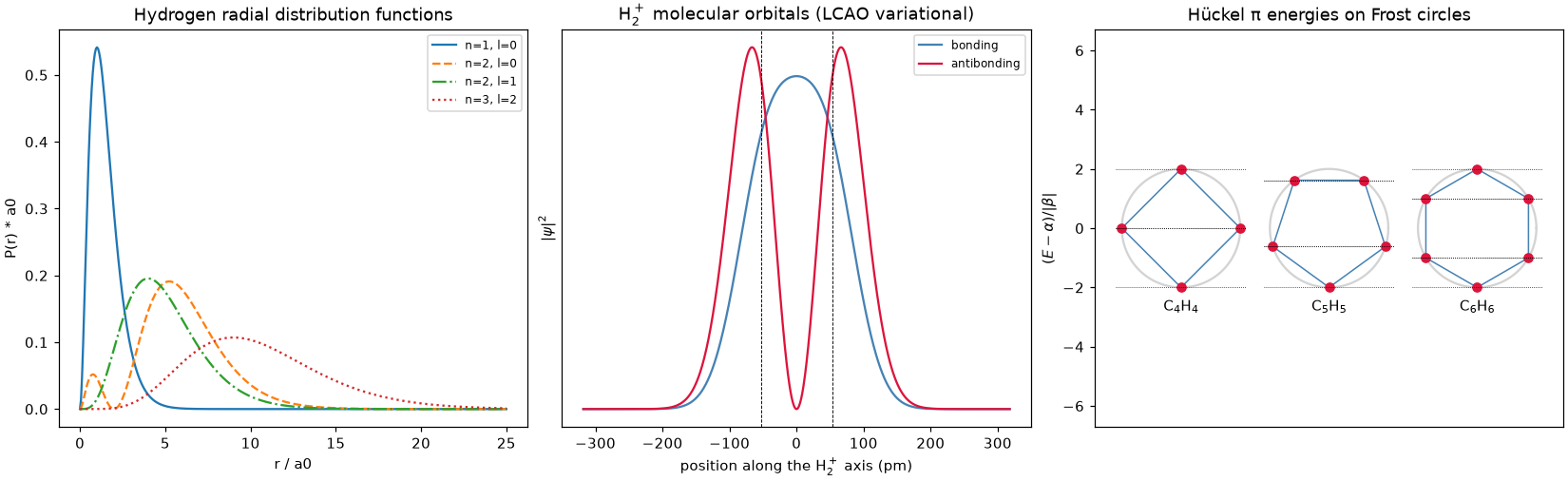
-
chemistrykit.spectro-- spectroscopy: the Beer-Lambert absorbance law and its stray-light deviation from linearity; rigid-rotor rotational spectra with isotope shifts; harmonic vs. Morse vibrational band positions plus a Wilson GF-matrix triatomic normal-mode calculation; Franck-Condon vibronic progressions; Gaussian/Lorentzian/Voigt lineshapes (scipy.special.wofz); and first-order NMR multiplets, exact second-order (AB, ABX) spectra, and Fourier-transform NMR (numpy.fft).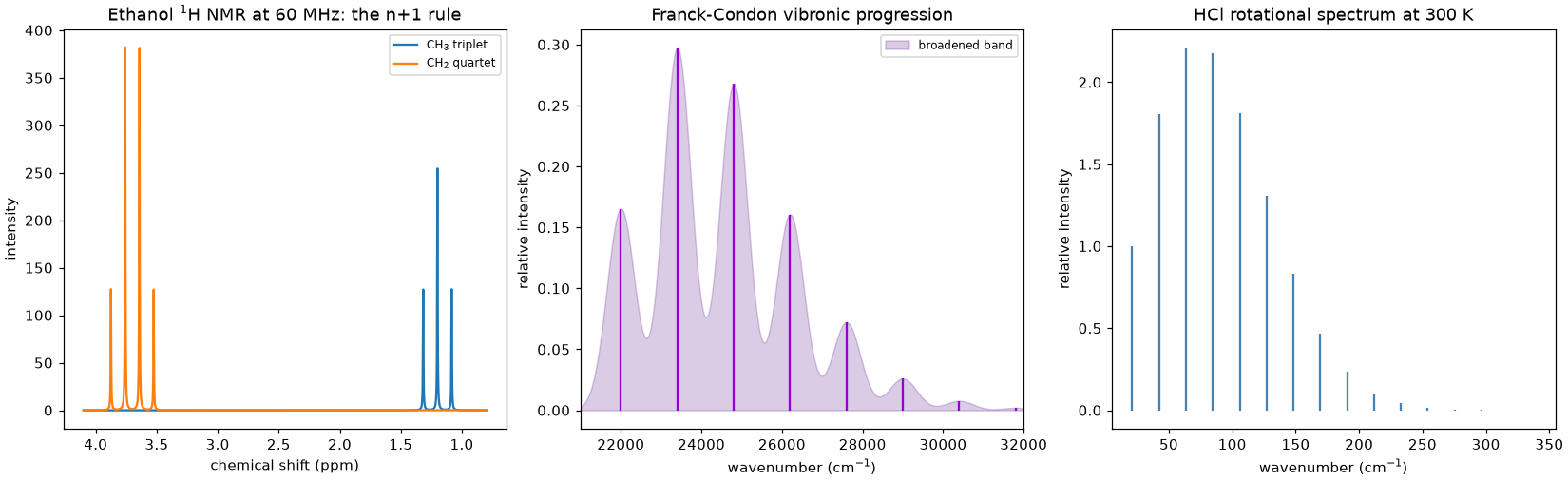
-
chemistrykit.structure-- molecular structure and bonding: a lightweightMoleculecontainer; VSEPR geometry prediction with real 3D coordinate generation; point-group determination from 3D coordinates and character tables (hand-rolled); bond order from the Pauling length correlation and Huckel-theory MO coefficients; and formal-charge/oxidation-state assignment from a Lewis structure.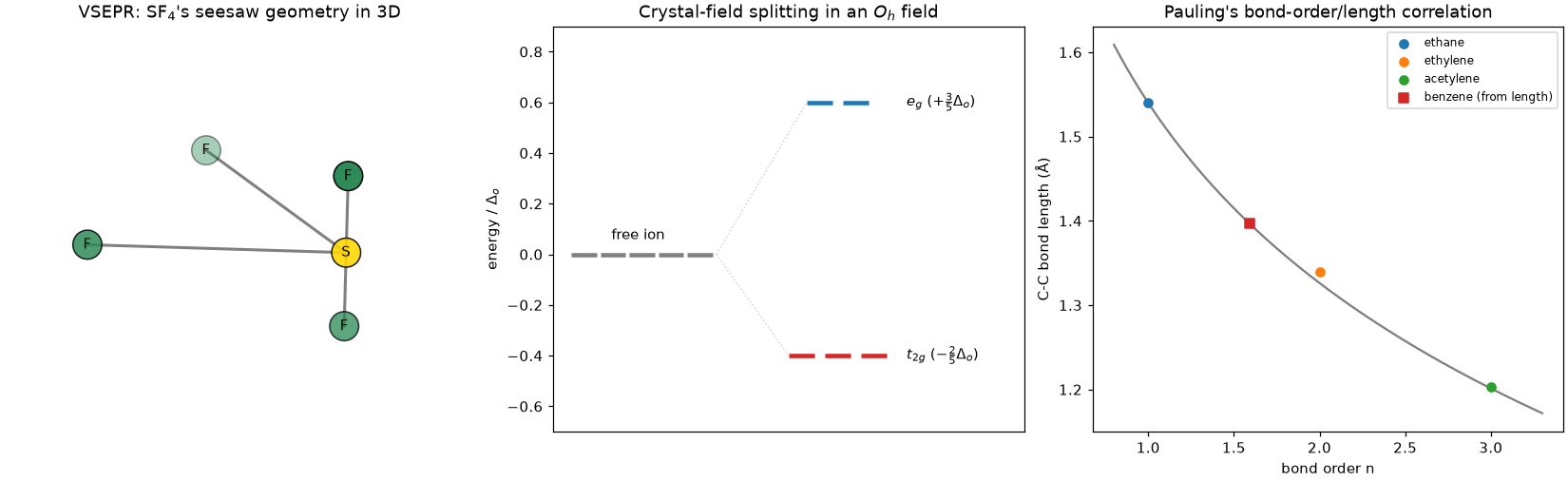
-
chemistrykit.electrochem-- electrochemistry: the Nernst equation for standard and concentration cells with Debye-Huckel activity corrections; a curated standard-reduction-potential table with redox-couple balancing; Butler-Volmer electrode kinetics and Tafel-plot linearization; galvanic vs. electrolytic cells and Faraday's laws of electrolysis; Cottrell, Ilkovič and Randles-Ševčík voltammetry; and a simplified constant-current battery discharge model with Peukert's-law rate dependence.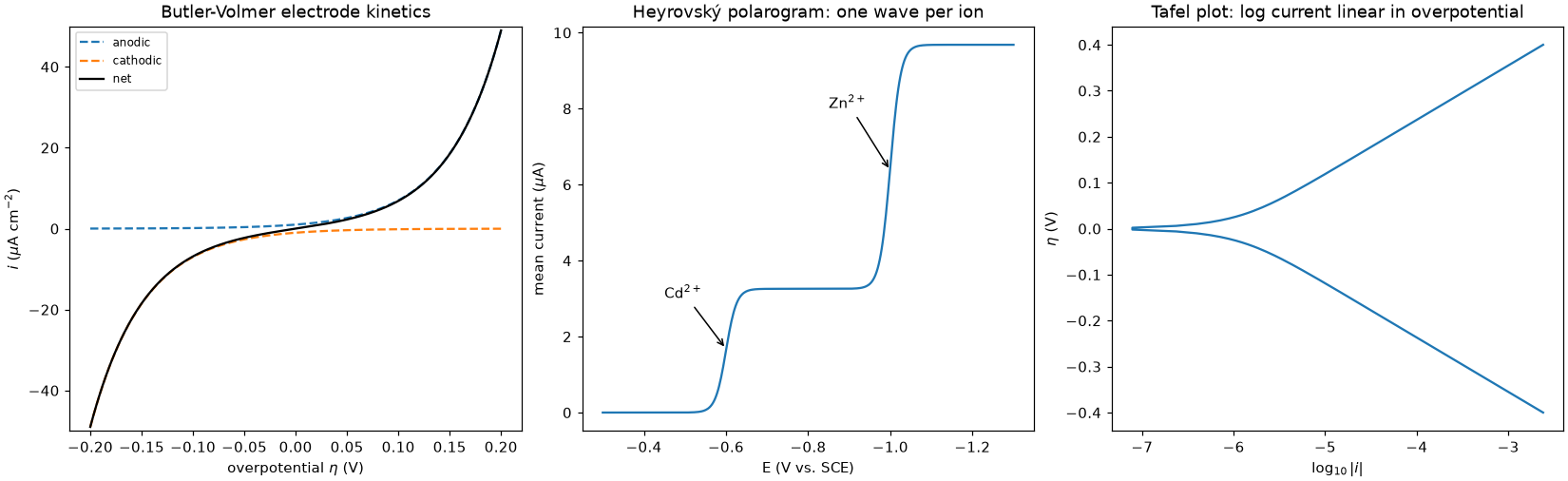
-
chemistrykit.photochem-- photochemistry: Jablonski-diagram excited-state kinetics built onchemistrykit.kinetics's reaction-network engine; fluorescence/phosphorescence quantum yields and the photochemical quantum yield via Beer-Lambert; Stern-Volmer quenching with a static-vs-dynamic diagnostic; Förster and Dexter energy transfer; and photostationary-state kinetics for a two-state photoswitch.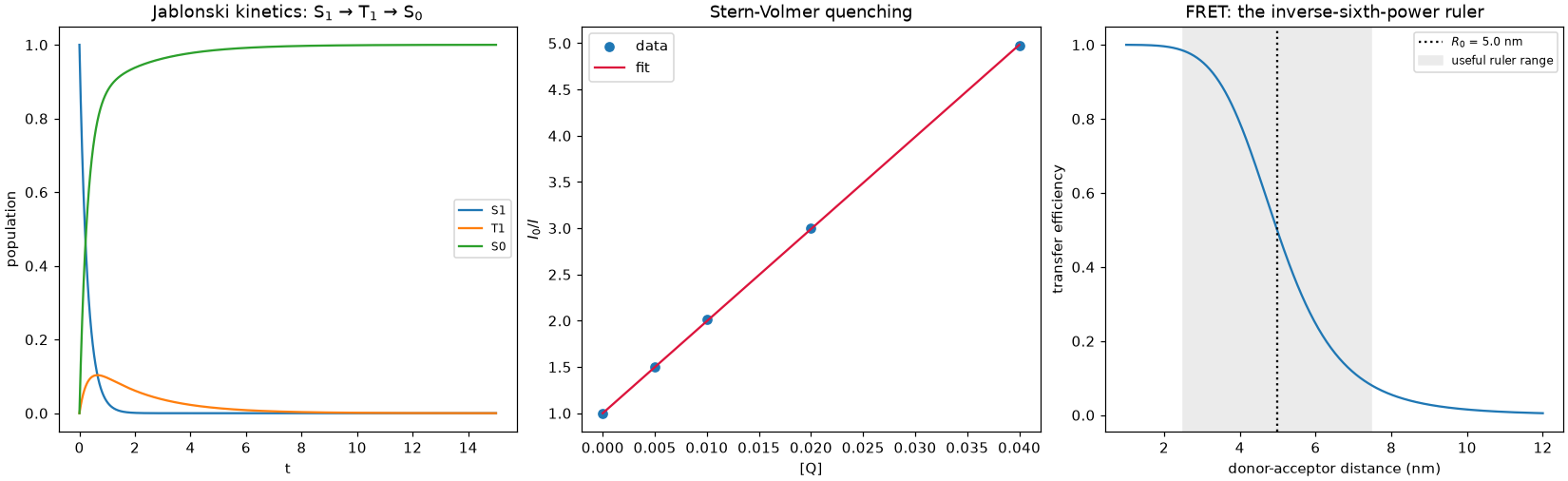
-
chemistrykit.surface-- surface chemistry and catalysis: Langmuir, Freundlich, BET, Temkin, and Dubinin-Radushkevich adsorption isotherms with their standard linearizations for fitting parameters from data; Langmuir-Hinshelwood single- and dual-site and Eley-Rideal surface-reaction kinetics; temperature-programmed desorption with Redhead analysis (scipy.integrate.cumulative_trapezoid); and a turnover-frequency/rate-enhancement catalysis model built onchemistrykit.kinetics's Arrhenius equation.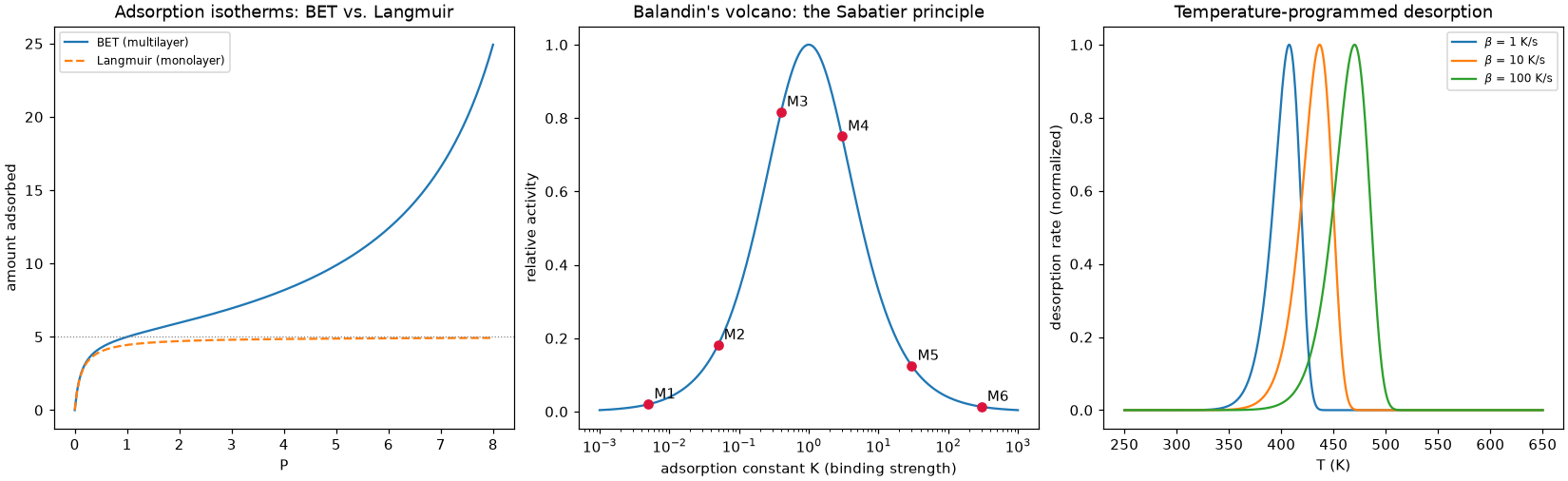
-
chemistrykit.polymer-- polymer chemistry: ideal random-walk chain statistics and the Flory exponent for real chains under theta/good/poor solvent conditions; molecular-weight-distribution statistics and the closed-form Flory-Schulz distribution; Flory-Huggins mixing thermodynamics and spinodals; step-growth kinetics via the Carothers equation; and chain-growth/free-radical polymerization kinetics built onchemistrykit.kinetics's reaction-network engine.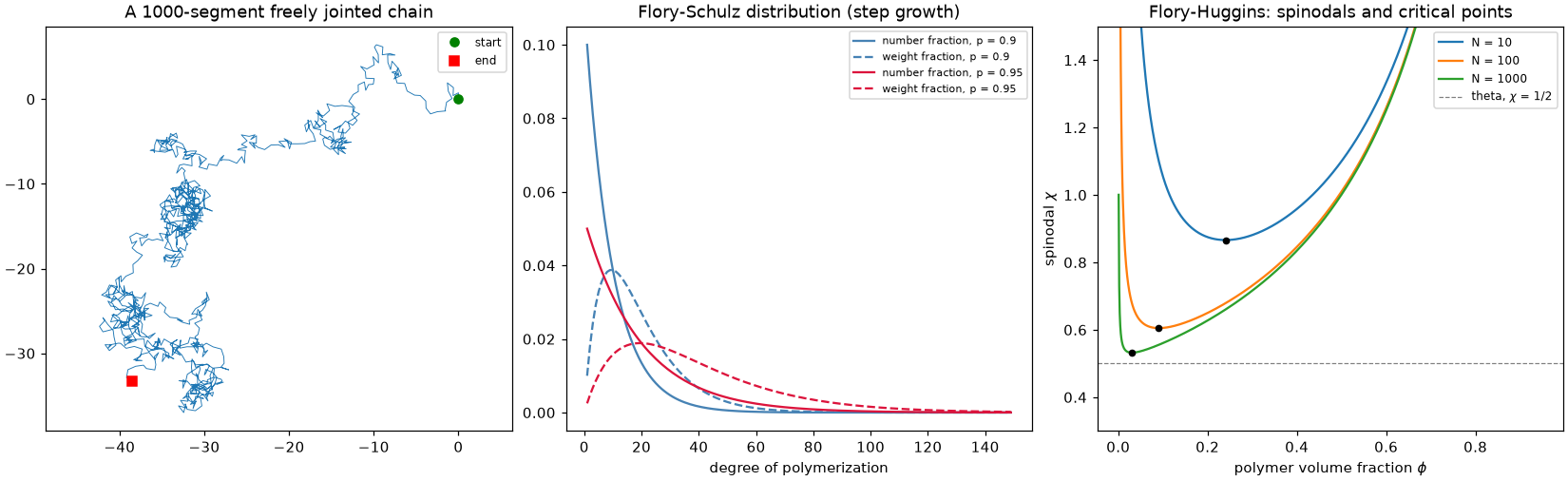
-
chemistrykit.crystal-- crystallography and solid-state chemistry: the 7 crystal systems and general unit-cell volume; hard-sphere packing (packing fraction, coordination number) for SC/BCC/FCC/HCP lattices; ionic-crystal lattice energy via the Born-Lande and Kapustinskii equations, backed by a genuinely converging (Evjen-method, hand-rolled) numerical Madelung constant; Bragg's law and powder-XRD peak positions with structure factors and systematic absences; and Schottky/Frenkel point-defect equilibrium.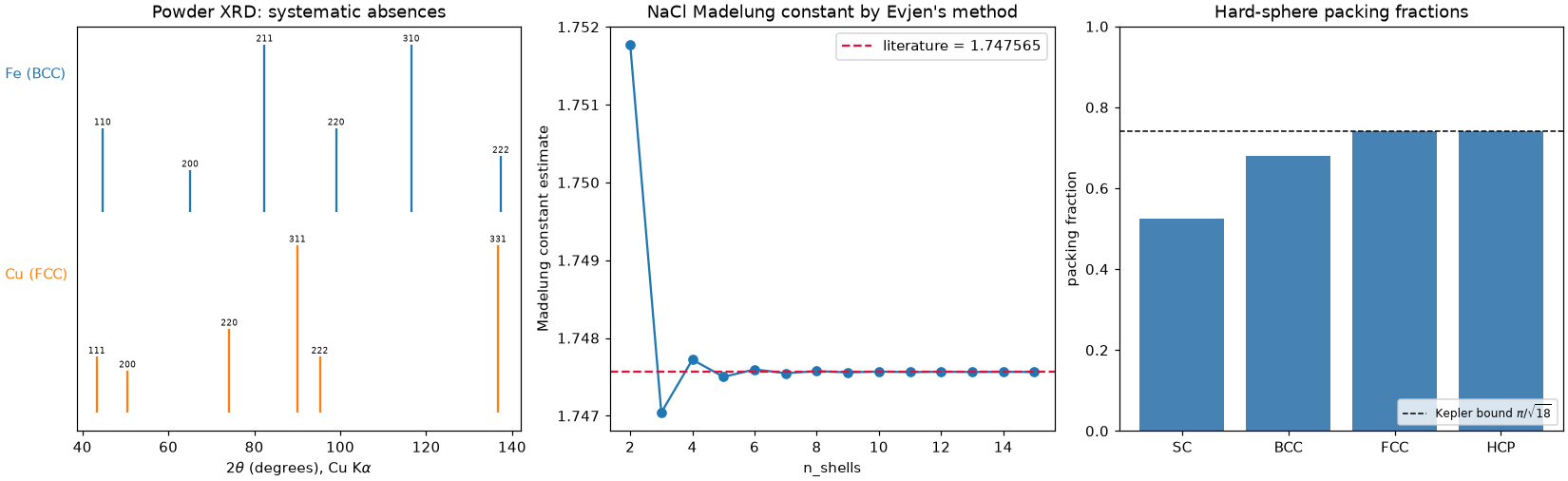
-
chemistrykit.analytical-- analytical chemistry: redox and complexometric (EDTA) titration-curve simulation with equivalence-point detection, alongsidechemistrykit.solutions's acid-base titrations; chromatographic plate theory and the van Deemter equation (resolution, selectivity); linear-regression calibration curves with IUPAC-convention limits of detection/quantitation; Savitzky-Golay smoothing (scipy.signal.savgol_filter); and propagation-of-uncertainty formulas plus Dixon's Q-test and Grubbs' test for outlier rejection (critical values viascipy.stats).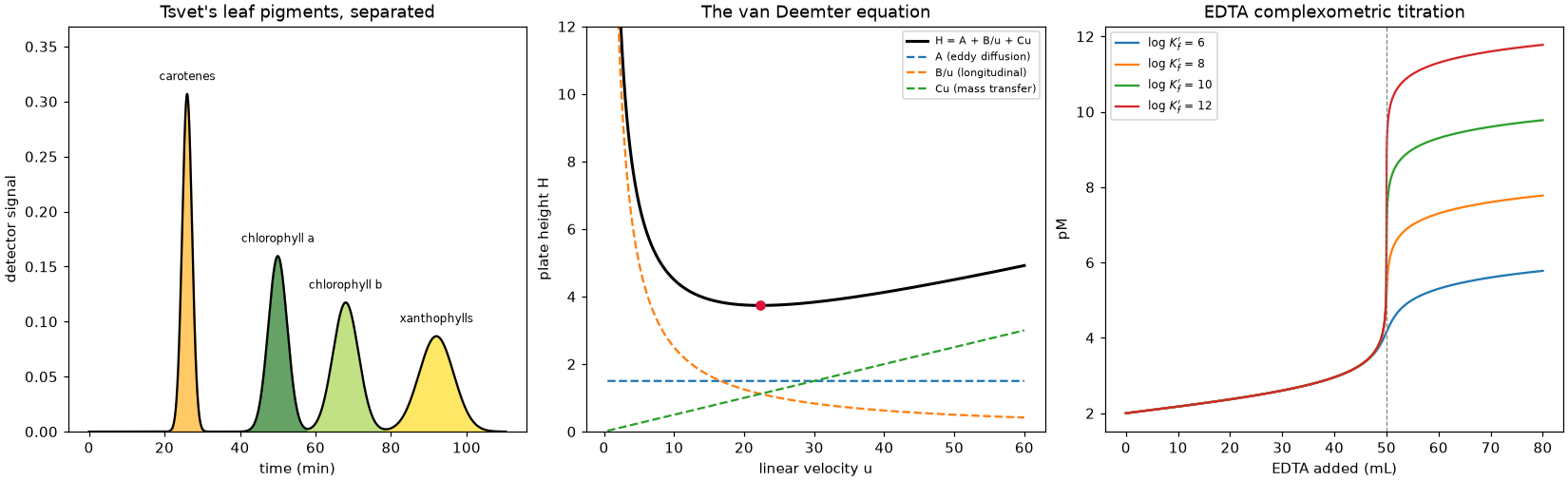
Shared infrastructure, used across the subpackages above rather than standalone toolkits:
chemistrykit.constants-- chemical constants (R, NA, k_B, Faraday's constant, ...) fromscipy.constants, plus a built-in periodic table (all 118 elements, with a chemical-formula parser, e.g.molar_mass("Ca(OH)2")) and a few well-defined unit conversions.chemistrykit.stoichiometry-- general equation balancing (including ionic and redox equations), limiting reagents, theoretical and percent yield, and empirical formulas from percent composition.chemistrykit.integrators-- shared numerical ODE integrators (RK4, leapfrog, Yoshida4, adaptive Dormand-Prince) used across the other subpackages.
Every function takes and returns plain floats and NumPy arrays; there is
no unit-tracking library and nothing checks that units are consistent.
Physical constants in chemistrykit.constants are SI values from
scipy.constants, and each docstring states the unit of every argument
and return value. Most models work in SI (J, m, Pa, K, mol/m^3). The
exceptions are the conventional ones, documented per function: solution
concentrations in mol/L, NMR shifts in ppm and couplings in Hz,
spectroscopic line positions in cm^-1, the Lennard-Jones fluid in
reduced units (sigma, epsilon, particle mass), and empirical correlations
(Antoine constants, activity-model and rate-constant parameters) in
whatever units their constants were tabulated in. Converting inputs to
the documented units is the caller's job.
chemistrykit calls numpy/scipy directly for anything they already
implement (root finding and minimization, quadrature, eigensolvers,
special functions, FFTs, Savitzky-Golay filtering, statistical
distributions), and hand-rolls an algorithm only where no
numpy/scipy equivalent exists (e.g. the stoichiometry-matrix
reaction-network engine, point-group determination, Madelung sums,
equation balancing) or where the algorithm's own steps are the
pedagogical subject (e.g. the Hartree-Fock SCF loop, MD integrators and
thermostats, Gillespie's stochastic simulation). No dependency on RDKit,
ASE, PySCF, OpenMM, or SMILES/PDB parsing. Performance-critical inner
loops (reaction-network right-hand sides, MD pair forces) are
numba-compiled, and the ODE integrators are shared across domains.
Tests live alongside each subpackage, at chemistrykit/<name>/tests/.
pytest                                              # everything
pytest chemistrykit/kinetics/tests                  # a single subpackage

# docstring examples, across every subpackage:
MPLBACKEND=Agg pytest --doctest-modules chemistrykit \
    --ignore-glob="*/tests/*"
Both commands, plus ruff check/ruff format --check, run in CI on
every PR (.github/workflows/ci.yml) across Python 3.10-3.15 on Linux and
macOS. See CONTRIBUTING.md before opening a PR.
MPLBACKEND=Agg pytest -q --cov=chemistrykit --cov-report=term774 tests, 96% line coverage overall. Per-subpackage coverage:
| Subpackage | Coverage | Subpackage | Coverage | |
|---|---|---|---|---|
analytical |
99% | solutions |
99% | |
crystal |
99% | spectro |
99% | |
electrochem |
99% | statmech |
99% | |
kinetics |
93% | structure |
98% | |
md |
89% | surface |
99% | |
photochem |
95% | thermo |
99% | |
polymer |
99% | integrators |
47% | |
quantum |
98% | constants |
84% |
visualizers/ modules are smoke-tested only (correct return type/shape,
or that anim.save() succeeds) rather than covered line-by-line, per the
testing convention in CLAUDE.md. integrators sits lower
because several of its fixed-step/adaptive methods aren't exercised
directly by its own tests, only indirectly through the subpackages
(kinetics, md) that call into it; constants includes a few
rarely-used unit-conversion helpers not hit by any test.
Built docs are hosted at https://cpoli.github.io/chemistrykit/, served
from the gh-pages branch. To build locally:
pip install -e ".[docs]"
cd docs && make html
See docs/source/history/ for a chronology of each domain's foundational
breakthroughs, linked to the corresponding implementation at each step.
The README figures are regenerated with python docs/make_readme_figure.py
and python docs/make_readme_subpackage_figures.py.
If you use chemistrykit in your research, please cite it — see CITATION.cff.
See CONTRIBUTING.md. Please note that this project follows the Contributor Covenant.
MIT -- see LICENSE.