Repository navigation
[Feature] Server needs a storage-aware readiness signal (readiness stays green with zero Stores) #3212
Description

Feature Description (功能描述)
The Server has no endpoint a Kubernetes readiness probe can use that reflects whether it can actually serve graph traffic. /versions (what the #3132 chart uses today) answers 200 as long as the REST layer is up, even when the cluster has no Store at all.
Measured independently by @SebastianGruza on 2026-09-16 (#3132, comment of 19:31 CEST; scripts in SebastianGruza/hugegraph-validation, docs/helm-chart-faults.md scenario 7): with all Stores scaled to 0 on a running cluster, the Servers stayed Running and ready=true with 0 restarts for 150+ seconds, /versions answered 200 throughout, while every GET /graph/vertices/<id> ended in a 500 after the 30 s request bound (#3204). A Kubernetes Service therefore keeps routing traffic to Servers whose every real request fails.
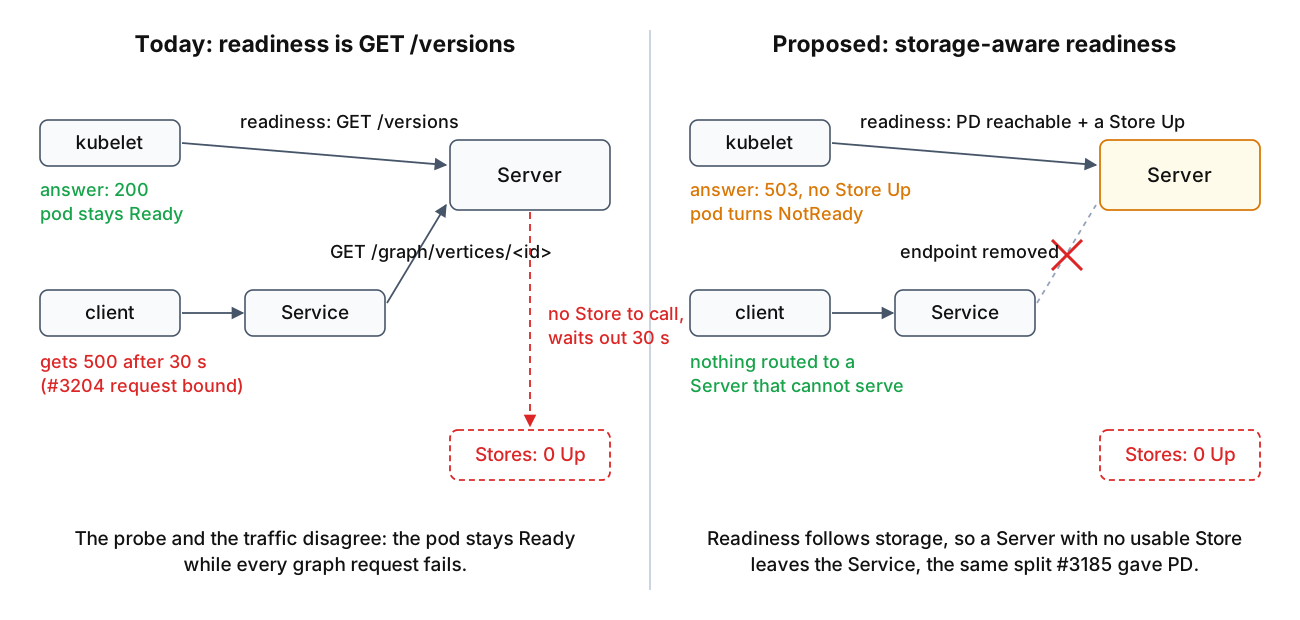
This is the Server-side twin of #3183, which was fixed for PD by #3185's unauthenticated /v1/ready.
Proposal: an unauthenticated, cheap readiness endpoint on the Server (for example /apis/readiness or a flag on /versions) that returns 503 unless:
- the Server's PD client currently has a usable PD connection, and
- at least one Store is registered and Up from that Server's view (the graph list from PD plus one cheap Store call is the shape suggested in the feat(helm): add HStore deployment chart #3132 thread).
It must not require Basic auth: a Kubernetes httpGet probe cannot carry a credential without leaking it into the pod spec, which is exactly why #3185 made /v1/ready unauthenticated and why the auth interceptor already excludes /actuator/**, /v1/health and /v1/ready on PD.
Chart side once this exists: server.readinessPath flips from /versions to the new path the same way pd.readinessPath moved to /v1/ready, and a Server with no working storage drops out of the Service instead of serving 500s.
Visual summary

Activity
SebastianGruza commentedon Sep 18, 2026
I'm taking this one, as agreed with the chart author. Design below so it can be rejected before the PR; the code exists locally, the E2E on k3s is running, and the PR will come with the measurements.
Endpoint
GET /readiness, unauthenticated (added toFIXED_WHITE_API_SETnext toversions), 200 or 503, JSON without addresses:A separate path rather than a flag on
/versions, because/versionsis the chart's startup and liveness probe today and should stay "the REST layer is up"; readiness has a different meaning and a different blast radius./apis/readinessfrom the proposal is out, since/apisbelongs to ProfileAPI.Definition of "ready"
PDClient.getActiveStores()within the time budget.HgStoreNodeManagerandexistsTable("g+v"), i.e. oneTable/EXISTSRPC that touches no data. Answering counts, not the answer. Stores are tried in turn; the first one that answers ends the probe.Why "at least one" and not "all": readiness answers whether this server can serve traffic, not whether the cluster is healthy. During a rolling restart of the stores one is always on its way; requiring all of them would pull every server out of the Service on every roll, which is exactly the flapping the chart author asked about. The zero-store case from #3132 is caught either way. PD's view can be stale (measured: PD showed a store as Up 200 s after
kill -9), hence step 2 is mandatory.Cost and bounding
readiness.timeout(ms, default 1000): PD and each store get the remaining budget, calls go through an executor withFuture.get(remaining), so a hung PD or store yields a 503 with "did not answer within N ms", never a hung probe.readiness.cache_ttl(ms, default 2000): kubelet, a load balancer and a human with curl share one PD call and one store RPC per window. 0 disables the cache."storage":"embedded".Where it lives
hugegraph-hstore:HstoreStorageProbe(pure logic over two functional interfaces, the active-store list and the ping, plus the wiring throughHstoreSessionsImpl.getDefaultPdClient()andHgStoreNodeManager);HstoreStoreregisters astorage_readinessmeta handler.hugegraph-api:ReadinessAPI(@Path("readiness"),@PermitAll) andStorageReadiness(graph selection, cache, mapping to 200/503), called through the existingHugeGraph.metadata(null, "storage_readiness", timeout)hook. The api module does not depend on hstore or on the store client, and stays that way.ServerOptions:readiness.timeout,readiness.cache_ttl.Tests
HstoreStorageProbeTest(9: PD fails, PD hangs within the budget, zero stores, every store fails, first answering store after two failures, hung stores within the budget, no addresses in the result),StorageReadinessTest(5: cache, TTL 0, probe exception as 503 with a reason, budget passed through, copy isolation)./readiness,/versions, the Ready condition and the Service endpoints on every server pod): baseline, stores → 0 and back, one store deleted, rolling restart of the stores under load, PD → 0 and back, rolling restart of PD, SIGSTOP on the store leading the most partitions. Criteria: with stores → 0 every server leaves the Service; on every roll not a single Ready → NotReady transition. Results go into the PR and to feat(helm): add HStore deployment chart hugegraph/hugegraph#221.Chart side
server.readinessPathdefaulting to/versions, switched to/readinesson images that serve it, exactly likepd.readinessPath; startup and liveness stay on/versionsso a server that merely lost its storage is not restarted. The diff for #221 is ready and will go with the measurements.What I'm not doing: probing every graph and every store, checking partition leaders, an authenticated variant of the endpoint. If any decision above is wrong, now is the cheapest moment to say so.
SebastianGruza commentedon Sep 18, 2026
PR is up: #3221.
The design held, with two corrections the k3s runs forced (both kept as evidence in the validation repo):
existsTable(a raft-routed call over the shared session pool). It flapped on a rolling restart of the Stores and of PD (200→503→200 several times per Server) because a healthy node's ping waited behind a leaving one. Replaced by a direct, local, read-onlyHgStoreState.getScanStateper node over the probe's own channels, fired in parallel, first answer wins.pd_reachable.Final E2E on a 3-node k3s with the #3218 chart, 1 Hz sampling of /readiness, /versions, the Ready condition and the Service endpoints per Server pod, load through the Service: 7 PASS. Stores→0 pulls every Server out of the Service in ~30 s and back ~20 s after they return; rolling restart of Stores and of PD show zero readiness transitions; PD→0 stays 200 with pd_reachable=false; SIGSTOP on the busiest Store shows zero transitions. Scripts, per-scenario JSON and the two superseded designs: https://github.com/SebastianGruza/hugegraph-validation/tree/master/results/issue-3212
Chart side (
server.readinessPath, default /versions, mirroring pd.readinessPath) is ready as a diff for hugegraph#221.feat(helm): make the Server readiness path configurable
bitflicker64 commentedon Sep 24, 2026
The Helm chart in #3218 carries the interim knob for this:
server.readinessPath, default/versions, documented in the chart README's Server table as the value to move once this endpoint exists. When this fix merges: if #3218 has merged, add a chart TODO to switch the default and retire the caveat; if it is still open, comment there so the default is switched and re-tested in the same PR.feat(server): add a storage-aware GET /readiness endpoint
github-actions commentedon Oct 9, 2026
Due to the lack of activity, the current issue is marked as stale and will be closed after 20 days, any update will remove the stale label
feat(server): add a storage-aware GET /readiness endpoint
SebastianGruza commentedon Oct 10, 2026
Still active: the implementation is in #3221, round 8 pushed today (3932be6). The issue stays open until that PR is merged or closed.
github-actions commentedon Oct 27, 2026
Due to the lack of activity, the current issue is marked as stale and will be closed after 20 days, any update will remove the stale label