


MkFont is a free (libre) app that builds fonts from shapes drawn elsewhere: SVG files in, a font file out. Glyphs are fitted between the font's metrics by settings that can change at any time, built from each other with reusable components, and joined by ligatures and kerning pairs. MkFont exports TrueType and OpenType fonts and their web versions (WOFF, WOFF2).
Download · Documentation · Quick start
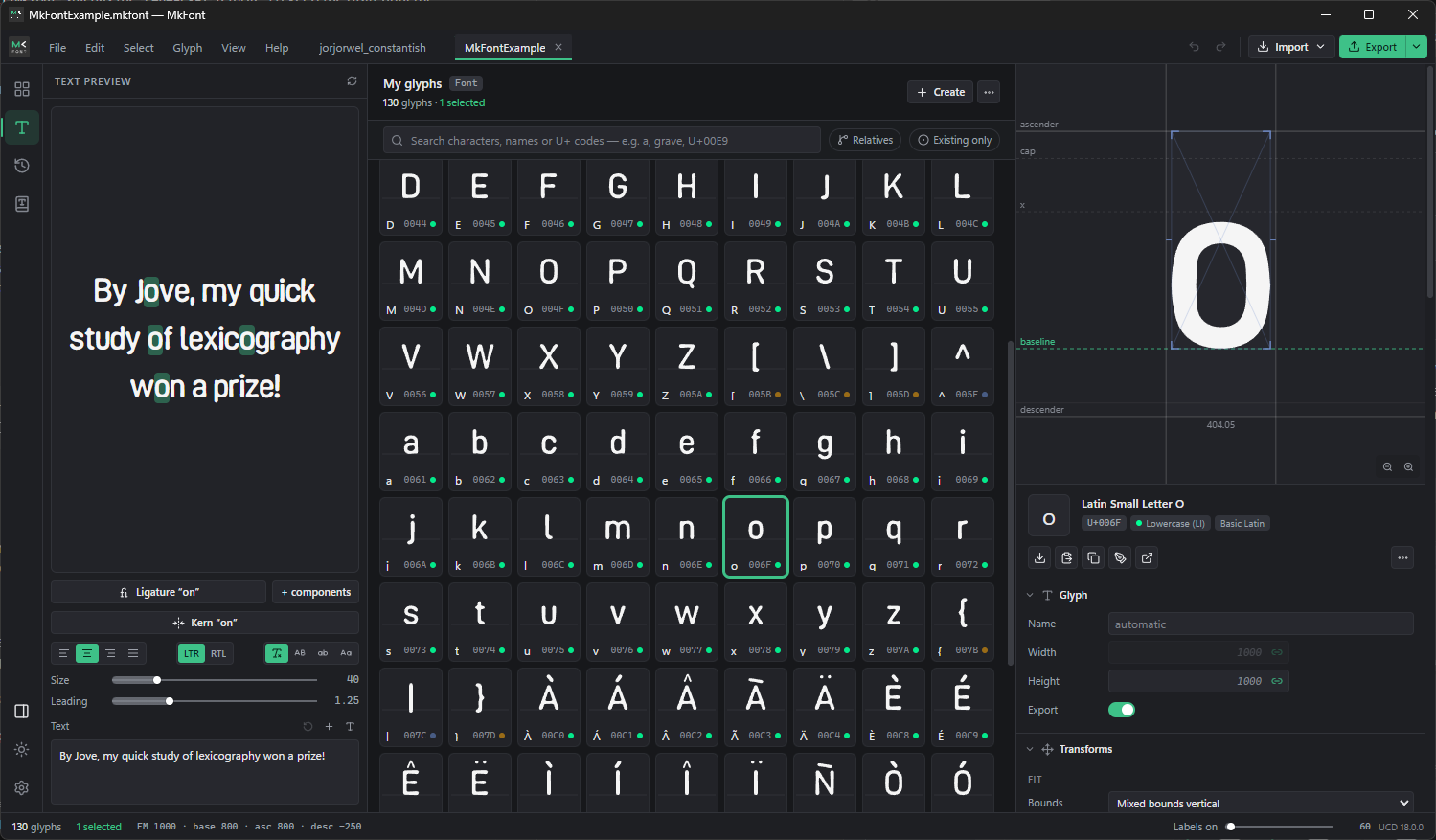
Installers for Windows, macOS (Apple silicon and Intel) and Linux are attached to each release. MkFont needs a 64-bit Windows, or macOS 13 (Ventura) or later.
They are not code-signed, so the system asks before the first launch:
- Windows: SmartScreen shows "Windows protected your PC". Choose More info, then Run anyway.
- macOS: open the app once, then allow it under System Settings › Privacy & Security › Open Anyway.
- Linux: make the AppImage executable (
chmod +x MkFont-*.AppImage), then run it.
MkFont 2 is a rewrite of MkFont on Electron, React and TypeScript. It opens and saves the same .mkfont files, and adds:
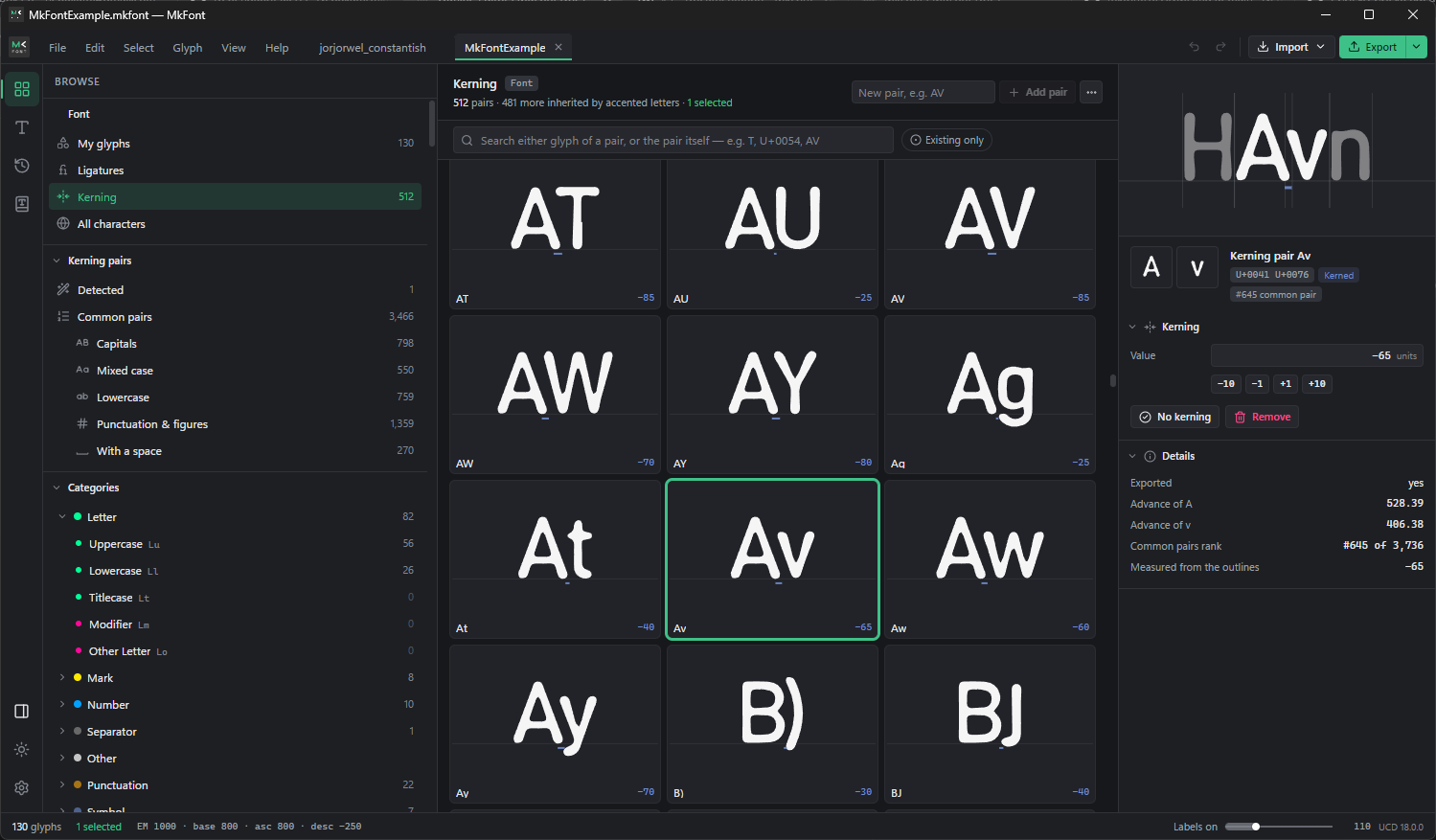
- Kerning pairs, with lists of common pairs to work through and pairs detected from the outlines. They are saved under a key MkFont 1 ignores: MkFont 1 still opens the file, and drops the pairs if it saves it.
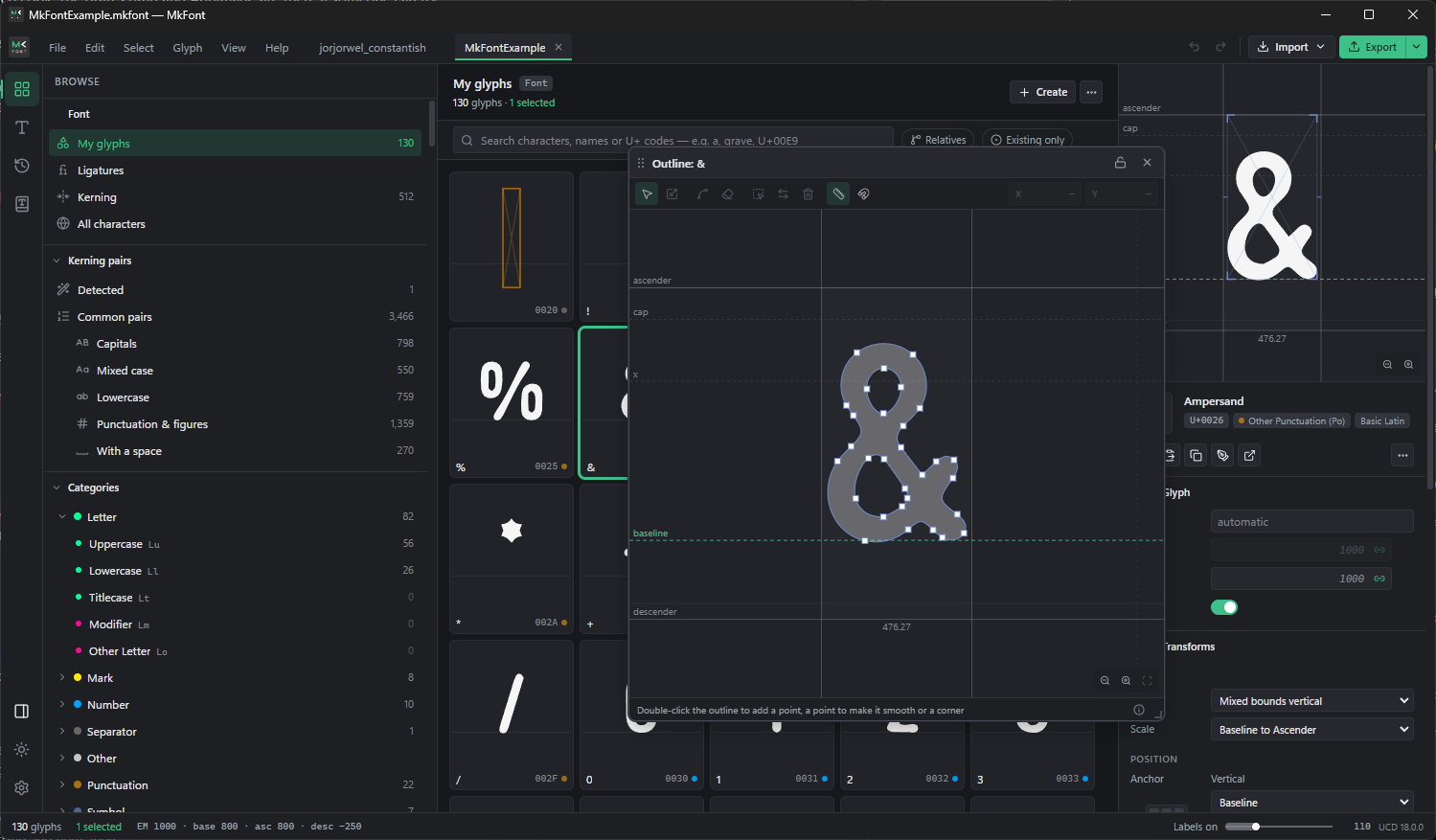
- An outline editor to adjust the points of an imported shape in place. It edits what is there; drawing from scratch stays with your vector editor.
- OTF, WOFF and WOFF2 export, and several formats at once.
- A command palette, context menus, keyboard navigation, light and dark themes, and an interface in English, French, Spanish and Simplified Chinese.
Coming from MkFont 1 lists what moved and what changed.
MkFont 1 is kept on the archive/v1 branch, and its installers stay on the releases page.
MkFont needs Node.js 24 or later.
npm install
npm run dev
npm run dev starts the Electron app with hot reload. npm run dev:web serves the editor in a plain browser at http://localhost:5199 (file dialogs fall back to file inputs and downloads).
| Script | What it does |
|---|---|
npm run dev |
Electron app in development mode |
npm run dev:web |
Browser-only build of the editor |
npm test |
Unit tests (transform engine, file format, import/export, history, translations) |
npm run typecheck |
TypeScript checks for the renderer and the Electron processes |
npm run check:i18n |
Looks for interface text written outside the translation catalogs |
npm run build |
Production bundles in out/ |
npm run build:unpack |
Unpacked app in dist/ (quick packaging check) |
npm run build:win |
Windows installer in dist/ |
npm run gen:unicode -- <ucd-dir> |
Regenerates the Unicode data from a UCD download (UnicodeData.txt, Blocks.txt) |
npm run gen:kerning-pairs -- <file> |
Regenerates the common kerning pairs from result/relevant_kerning_raw.json of andre-fuchs/kerning-pairs |
npm run gen:icon |
Renders build/icon.png from src/renderer/src/assets/mkfont-logo.svg |
src/main/                 Electron main process (dialogs, file watching, window state)
src/preload/              IPC bridge exposed as window.api
src/renderer/src/
  core/                   Framework-free logic: transform engine, composition, file format,
                          SVG/font import, font export, Unicode data
  stores/                 Zustand stores: document + undo history, selection, UI, preferences
  app/                    Commands, shortcuts, clipboard, import flows, document lifecycle
  components/             React UI (shell, grid, inspector, side panels, dialogs, primitives)
  platform/               Electron / browser abstraction for files and clipboard
  locales/                Interface text, one folder per language
src/renderer/public/      Files shipped as they are: the sample font
build/icon.png            App icon (1024 px); electron-builder derives .ico / .icns from it
docs/                     Notes for contributors
- Every edit goes through
transact(label, recipe)instores/doc-store.ts; it records an undo step and recomputes only the glyphs affected. - The transform engine (
core/transform.ts,core/compute.ts) is a faithful port of MkFont 1. It was checked against the layer placements MkFont 1 saved in a font when it was ported;core/__tests__/engine.test.tsnow guards it against the placements saved in the sample font. - The sample font the app offers is
src/renderer/public/MkFontExample.mkfont: replace that file to update it. The tests run on it too, and a few rely on what it contains (Àbuilt fromAand a grave accent, the usual Latin letters, no ligatures). - Everything in
src/renderer/public/ships with the app. Personal test fonts go inlocal/, which Git ignores. - In development builds,
window.__mkfexposes the stores and actions for scripted UI checks, and?mock-electronreplaces the Electron API with an in-memory mock to exercise desktop-only flows in a browser. - The
electronandelectron-prodentries in.claude/launch.jsonstart the real app (dev server or built bundles) with Chrome remote debugging on ports 9333 / 9334, so the running window can be driven through the DevTools protocol. - Every library the app uses is listed in
devDependencies: Vite bundles them into the renderer, and the main and preload processes only need Electron and Node. Nothing fromnode_modulesends up in the packaged app. - The package is named
mkfont2on purpose. Electron names the app's settings folder after it (%APPDATA%\mkfont2on Windows), andmkfontis the folder MkFont 1 uses: renamed, MkFont 2 would start in MkFont 1's profile and lose its own. - macOS builds have no signing certificate.
scripts/adhoc-sign.cjsgives the app an ad-hoc signature while it is packaged, so that a downloaded copy can be allowed in System Settings. - Releases are built by
.github/workflows/release.yml: set the version inpackage.json, push a tag with the same number (v2.0.0), then publish the draft release the run creates. Run workflow on the Actions page builds the installers without a release. - The outline editor (
components/outline-editor) edits a glyph's imported path (pathData.path) through the fit matrix compute exposes (VariantComputed.ownMatrix): points are shown in font units and stored back in the path's own space, onetransactper gesture. Its engine (engine/) is the only code that uses Paper.js; it has no React and runs in the Node tests. - Production builds get a Content Security Policy (
electron.vite.config.ts); the dev server runs without one because React refresh needs inline scripts. - Packaging on Windows needs symlink rights (Developer Mode or an elevated shell): electron-builder unpacks its
winCodeSigntools, which contain symlinks, before it writes the executable's metadata.
The interface is translated through catalogs, one folder per language, and a new language is welcome.
Adding a language walks through it, from copying the English files to the checks a translation has to pass. The conventions for interface text in the code are in docs/i18n.md.
MkFont wouldn't be possible if not for the @fontello folks sharing their magic: font export is built around svg2ttf and svgpath.
It also stands on opentype.js, Paper.js, SVGO, the Unicode database, and André Fuchs' kerning-pairs (MIT, see src/renderer/src/data/kerning-pairs.LICENSE.md).
MIT.
MkFont 2 was built with the help of Claude Code.
MkFont 1 was written by hand, on a framework of my own. It had reached the point where everything I still wanted for it (kerning, an outline editor, a codebase other people could contribute to) meant a rewrite I was never going to find the time for. Working with Claude is what made that rewrite possible.
It was not generated and shipped. The design and the decisions are mine, and so is the stubbornness about details: every feature was specified, tried on real fonts, and sent back until it behaved, with tests that hold the engine to what MkFont 1 computed. What came out is the MkFont I had wanted to make for a long time, and a better one than I could have made alone. It's a more robust and more maintainable tool that it could ever have been, and it will continue to improve.
I know this is a charged subject, and I understand the people who are uneasy about it. I only hope MkFont 2 gets judged on what it is, and that the care and the work that went into it still shows.