


Run DFloat11 checkpoints on a Mac with MLX. The weights stay about 30 % smaller than BF16 in memory, and the GPU decodes each block back to exactly the same bits just before it runs. It generates images on a 32 GB Mac with FLUX.1, Z-Image, FLUX.2 Klein, Qwen-Image-2.1, ERNIE-Image and Krea 2.
DFloat11 is lossless compression for BF16 model weights. Each weight is 16 bits. DFloat11 stores the 8 exponent bits as a short variable-length code, the same idea a zip file uses, and keeps the other 8 bits (the sign and the fraction) exactly as they are. The DFloat11 authors report models at about 70% of their BF16 size with output that is bit for bit the same as the original.1 Their decoder runs on NVIDIA GPUs only. This project is an independent reader and decoder for Apple Silicon. The weights stay compressed in memory, and a Metal kernel decodes each block on the GPU as it runs.
one BF16 weight, 16 bits:    s   eeeeeeee   mmmmmmm
                             |   |          |
                             |   exponent: replaced by a variable-length code   (compressed)
                             sign + fraction: kept as one raw byte              (stored as is)
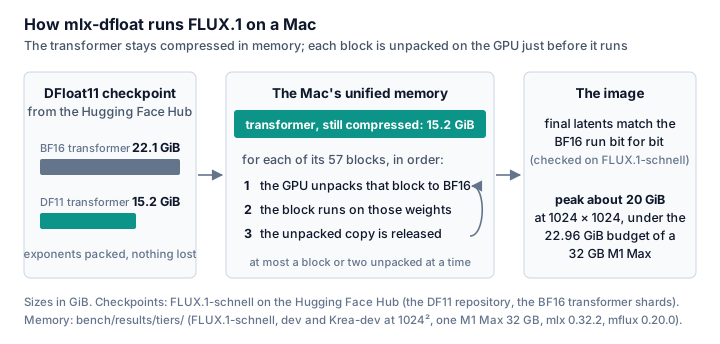
On a Mac, unified memory is the limit. The BF16 FLUX.1-dev transformer is about 24 GB,2 more than the GPU on a 32 GB machine can comfortably hold. At 70% it comes in under that line, and unlike 4-bit or 8-bit quantisation it changes nothing in the weights. On a 32 GB M1 Max a 1024² generation peaked at about 20 GiB for each of the three FLUX.1 models, and between 11.88 GiB (FLUX.2-klein-4B) and 21.17 GiB (Krea 2 Turbo) for the others; no other Mac has been measured. The numbers are under "Measured numbers" below.
| Your situation | What to use |
|---|---|
| A 32 GB Mac, FLUX.1-schnell, FLUX.1-dev or FLUX.1-Krea-dev, and you want the BF16 weights unchanged | mlx-dfloat. Measured peak about 20 GiB at 1024² for all three. The final latents were checked bit for bit against BF16 on FLUX.1-schnell, not yet on the other two. Unpacking makes a denoising step 3.5 % slower on dev and 4.0 % slower on schnell than a control that runs the same graph on weights decoded in advance (Krea-dev's step was not timed). |
| Less memory or a faster step, and a different image is fine | mflux's own quantised transformer. Its 8-bit mode, the only one measured here, ran a step roughly 1.3 times faster and peaked about 5 GiB lower, under the same 2.5 GB cache limit; mflux's own generate sets no cache limit, so this is not quite its default setup (see "Measured numbers" for why the ratio is rough). It changes the weights and the output; by how much was not measured. |
| A 32 GB Mac, Z-Image-Turbo or Z-Image, with the weights unchanged | mlx-dfloat. Peak at 1024²: 13.1 to 14.3 GiB for Z-Image-Turbo over six runs, 13.15 GiB for Z-Image. See "Generate a Z-Image image". |
| A 32 GB Mac, FLUX.2 Klein (4B or 9B, base or distilled), with the weights unchanged | mlx-dfloat. Peak at 1024²: 11.88 to 12.78 GiB for the 4B models, 17.60 to 18.40 GiB for the 9B models. See "Generate a FLUX.2 Klein image". |
| A 24 GB Mac, FLUX.2 Klein | CAPPED: FLUX.2-klein-base-4B passed, peak 12.29 GiB; FLUX.2-klein-base-9B is at risk (the fit check refuses it, and a forced run was stopped by the watchdog). See "Generate a FLUX.2 Klein image". |
| A 16 GB Mac, FLUX.2-klein-base-4B | CAPPED: passed, peak 8.15 GiB. See "Generate a FLUX.2 Klein image". |
| A 16 GB Mac, Z-Image-Turbo | CAPPED: at risk. The fit check refuses it, and a forced run was stopped by the watchdog at 9.26 GiB before the transformer ran. See "Generate a Z-Image image". |
| A 32 GB Mac, Qwen-Image-2.1, with the weights unchanged | mlx-dfloat. Peak at 1024²: 20.42 GiB. See "Generate a Qwen-Image-2.1 image". |
| A 16 GB or 24 GB Mac, Qwen-Image-2.1 | CAPPED: at risk. The fit check refuses it, and forced runs were stopped by the watchdog while the prompt was being encoded, before the transformer ran. See "Generate a Qwen-Image-2.1 image". |
| A 32 GB Mac, ERNIE-Image or ERNIE-Image-Turbo, with the weights unchanged | mlx-dfloat. Peak at 1024²: 16.79 GiB for ERNIE-Image (50 steps), 17.34 GiB for ERNIE-Image-Turbo (8 steps). See "Generate an ERNIE-Image image". |
| A 24 GB Mac, ERNIE-Image-Turbo | CAPPED: at risk. The fit check refuses it, 0.39 GiB over the budget; a forced run passed with a 14.39 GiB peak, 0.11 GiB under the watchdog ceiling. See "Generate an ERNIE-Image image". |
| A 24 GB Mac, ERNIE-Image | CAPPED: at risk. The fit check refuses it, and a forced run was stopped by the watchdog. See "Generate an ERNIE-Image image". |
| A 16 GB Mac, ERNIE-Image or ERNIE-Image-Turbo | CAPPED: at risk. The fit check refuses both, and forced runs were stopped by the watchdog. See "Generate an ERNIE-Image image". |
| A 32 GB Mac, Krea 2 Turbo or Krea 2 Raw, with the weights unchanged | mlx-dfloat. Peak at 1024²: 21.17 GiB for Turbo at 8 steps, 21.15 GiB for Raw at 25 steps and for Raw with its model card's 52 steps at guidance 3.5. The fit estimate predicts a refusal at about 500 prompt tokens; only a 30-token prompt was measured. See "Generate a Krea 2 image". |
| A 16 GB or 24 GB Mac, Krea 2 Turbo or Krea 2 Raw | CAPPED: at risk. The fit check refuses both models, and forced runs were stopped by the watchdog while the compressed weights were loading, before the transformer ran. See "Generate a Krea 2 image". |
| A Mac with room for the BF16 transformer next to everything else | Plain mflux in BF16. There is nothing to decode. |
| A Mac with less than 32 GB | Not measured. The rows marked CAPPED are runs on the 32 GB Mac under the caps mlx-dfloat installs on a 16 GB or 24 GB Mac; the tables below make no other claim for those Macs. |
| Another model: an LLM, the 20B Qwen-Image models (the original Qwen-Image, Qwen-Image-2512, Qwen-Image-Edit) or FLUX.2-dev | Not wired up yet. The reader and the decoder handle all four published versions of the DFloat11 format, but generation covers only the models in the rows above. The 20B Qwen-Image models are planned for a later release, for Macs with more than 32 GB; none of them has been run for generation. |
Alpha: version 0.2.0 is on PyPI.
Released in 0.1.0:
- All four published versions of the DFloat11 checkpoint format decode to exactly the BF16 originals: every compressed tensor of Qwen3-4B, and sampled blocks of FLUX.1-schnell, FLUX.1-Krea-dev, Qwen-Image-Edit and Qwen-Image-Edit-2509.
- A Metal kernel decodes to the same bits as the CPU reference decoder, at about 50 GB/s on an M1 Max on its default
path, timed on Qwen3-4B and FLUX.1-schnell groups with
uv run python -m scripts.bench_decode_kernel --df11 <checkpoint dir> --groups <group names> --out decode.json. The records,bench/results/decode/qwen3-4b-layer0.jsonandbench/results/decode/flux1-schnell.json, give 49.9 to 54.2 GB/s, each the median of five timed repetitions (M1 Max, macOS 27.0, mlx 0.32.2). - FLUX.1-schnell, FLUX.1-dev and FLUX.1-Krea-dev make 1024² images through mflux, from the command line or from Python. For FLUX.1-schnell, the final latents match the same transformer run block by block from its BF16 weights bit for bit, and the saved images match pixel for pixel.
- One command per scenario reruns the step benchmark under "Measured numbers". A tier is a Mac memory size (16, 24
or 32 GB); the tier table has one row per model and tier, and each row is one
mlx-dfloat generaterun. mlx-dfloat generate, the parity scripts and the benchmark run under a memory watchdog that stops them when they cross its ceiling.
Released in 0.2.0:
- Z-Image-Turbo and Z-Image make 1024² images through mflux, from the command line or from Python. For Z-Image, every
one of the 271 compressed matrices and 250 other tensors equals the BF16 original
(
bench/results/parity/z-image/full-vs-bf16.json). Its final latents (1024², 4 steps, guidance 4.0) match bit for bit, and its images pixel for pixel, the same transformer streaming its BF16 weights one block at a time; both sides ran without mflux's step compilation (record:bench/results/identity/z-image-1024/compare.json). Z-Image-Turbo has no BF16 original, because its published transformer is FP32. Its 271 matrices decode on the GPU to the same bits as the CPU reference (bench/results/parity/z-image-turbo/kernel-vs-reference.json), and five sampled groups (32 of the 271 matrices) equal the FP32 original rounded to BF16, nearest even (bench/results/parity/z-image-turbo/sampled-vs-fp32-rounded.json). Turbo's latents have not been compared with a reference yet. - FLUX.2-klein-base-4B, FLUX.2-klein-4B, FLUX.2-klein-base-9B and FLUX.2-klein-9B make 1024² images through mflux, from
the command line or from Python. For FLUX.2-klein-base-4B, every one of the 105 compressed matrices and 64 other
tensors equals the BF16 original (
bench/results/parity/flux2-klein-base-4b/full-vs-bf16.json), and its final latents (1024², 4 steps, guidance 4.0) match bit for bit, and its images pixel for pixel, the same transformer streaming its BF16 weights one block at a time; both sides ran without mflux's step compilation (record:bench/results/identity/flux2-klein-base-4b-1024/compare.json). For the other three, the GPU decoder gives the same bits as the CPU reference on every compressed matrix (105 for FLUX.2-klein-4B, 149 for each 9B model), and sampled groups equal the BF16 originals: 29 matrices for FLUX.2-klein-4B, 41 for FLUX.2-klein-base-9B and 30 for FLUX.2-klein-9B. Each model's two records arekernel-vs-reference.jsonandsampled-vs-bf16.jsoninbench/results/parity/<model>/(flux2-klein-4b,flux2-klein-base-9b,flux2-klein-9b). Their latents have not been compared with a reference. - Qwen-Image-2.1 makes 1024² images through mflux, from the command line or from Python. Its DFloat11 checkpoint
(
mingyi456/Qwen-Image-2.1-DF11-ComfyUI) is a single file made for ComfyUI, with noconfig.jsonnext to it. mlx-dfloat carries the missing layout for that one published file, pinned to one revision on the Hub, and refuses a file without aconfig.jsonthat it does not recognise. Every one of the 225 compressed matrices and 72 other tensors equals the BF16 original inQwen/Qwen-Image-2.1(bench/results/parity/qwen-image-2.1/full-vs-bf16.json), and the GPU decoder gives the same bits as the CPU reference on all 225 (bench/results/parity/qwen-image-2.1/kernel-vs-reference.json). Its final latents match, bit for bit, those of the same transformer streaming its BF16 weights one block at a time, and the images match pixel for pixel. That check ran at 1024² for 4 steps at guidance 4.0. The negative prompt was a single space, so classifier-free guidance ran (record:bench/results/identity/qwen-image-2.1-1024/compare.json).scripts/verify_image.pyruns both sides without mflux's step compilation. - ERNIE-Image and ERNIE-Image-Turbo make 1024² images through mflux, from the command line or from Python. For
ERNIE-Image, every one of the 256 compressed matrices and 153 other tensors equals the BF16 original in
baidu/ERNIE-Image(bench/results/parity/ernie-image/full-vs-bf16.json), and the GPU decoder gives the same bits as the CPU reference on all 256 (bench/results/parity/ernie-image/kernel-vs-reference.json). Its final latents match, bit for bit, those of the same transformer streaming its BF16 weights one block at a time, and the images match pixel for pixel. That check ran at 1024² for 4 steps at guidance 4.0, so classifier-free guidance ran (record:bench/results/identity/ernie-image-1024/compare.json). For ERNIE-Image-Turbo, all 256 compressed matrices equal the BF16 original inbaidu/ERNIE-Image-Turboas well, read from the Hub one piece at a time (bench/results/parity/ernie-image-turbo/full-vs-bf16.json), and the GPU decoder matches the CPU reference on all 256 (bench/results/parity/ernie-image-turbo/kernel-vs-reference.json). Turbo's latents were not compared with a reference: that check needs its 16 GB BF16 transformer on disk. - Krea 2 Turbo and Krea 2 Raw make 1024² images through mflux, from the command line or from Python. Their DFloat11
checkpoints (
mingyi456/Krea-2-Turbo-DF11-ComfyUIandmingyi456/Krea-2-Raw-DF11-ComfyUI) are single files made for ComfyUI, with noconfig.json; mlx-dfloat carries the layout of each, pinned to one revision on the Hub. Both were checked in full against their originals inkrea/Krea-2-Turboandkrea/Krea-2-Raw, read from the Hub one piece at a time. The 256 matrices of the 28 transformer blocks and the four text-fusion blocks equal the BF16 originals. The originals store the other 5 matrices and the 169 other tensors in FP32, and the DFloat11 values equal them rounded to BF16, nearest even (bench/results/parity/krea-2/full-vs-original.jsonandbench/results/parity/krea-2-raw/full-vs-original.json). The GPU decoder gives the same bits as the CPU reference on all 261 matrices of each model (bench/results/parity/krea-2/kernel-vs-reference.jsonandbench/results/parity/krea-2-raw/kernel-vs-reference.json). Krea 2 Raw's final latents match, bit for bit, those of the same transformer streaming its original weights one block at a time, and the images match pixel for pixel. That check ran at 1024² for 4 steps at guidance 3.5, so classifier-free guidance ran (record:bench/results/identity/krea-2-raw-1024/compare.json). Turbo's latents were not compared with a reference: that check needs its 26 GB original transformer on disk. mlx-dfloat generate --tier 16and--tier 24run under the memory caps mlx-dfloat installs on a Mac of that size. The 16 GB and 24 GB rows under "Measured numbers" are CAPPED runs on the 32 GB Mac under those caps; no smaller Mac was measured.mlx-dfloat selftestchecks the GPU decoder on your Mac (see "Check the GPU decoder on your Mac").
Earlier step-time numbers, measured with a smaller MLX cache limit, are in the 0.1.0 entry of the changelog.
mlx-dfloat is for Macs with Apple Silicon and needs Python 3.11 or newer. Install it from PyPI:
pip install "mlx-dfloat[mflux]"
Without the extra you get the checkpoint reader and the decoder. The mflux extra installs mflux 0.20, which the
mlx-dfloat generate command needs for FLUX.1, Z-Image, FLUX.2 Klein, Qwen-Image-2.1, ERNIE-Image and Krea 2
generation.
The parity scripts and the benchmark live in the repository, not in the package, so run them from a checkout with uv:
git clone https://github.com/IonDen/mlx-dfloat
cd mlx-dfloat
uv sync --extra mflux
A plain uv sync installs the reader, the decoder and the parity scripts, and --extra mflux adds generation. The
benchmark runs with uv run --group bench, which installs mflux as well.
Every FLUX.1 base repository on the Hugging Face Hub is gated, so log in once with hf auth login and accept the
model's licence on its Hub page (details under "Generate a FLUX.1 image"). The Krea 2 bases are gated too (see
"Generate a Krea 2 image"). On disk, a DFloat11 FLUX.1 transformer
takes about 16 GB, and the base's text encoders, VAE and tokenizers about 10 GB more. The benchmark's q8
condition also needs the base's BF16 transformer, about 24 GB, which generation itself never downloads.
The parity check compares a published DFloat11 repo with its BF16 original over HTTP range reads, so it fetches only the blocks it checks instead of the whole model:
uv sync --group dev
uv run python -m scripts.verify_remote_group \
  --df11-repo DFloat11/FLUX.1-schnell-DF11 \
  --bf16-repo black-forest-labs/FLUX.1-schnell --bf16-subdir transformer \
  --groups max-code --out result.json
A few gigabytes move over the network, so expect a few minutes. The script exits 0 when every compared value
matches, 1 on a real mismatch, and 2 on any other problem such as a repo it cannot read. It runs under a memory
watchdog and stops itself with exit 70 or 71 if it gets close to the machine's memory or to its time limit. For a
checkpoint that is already on disk, scripts/verify_checkpoint.py (run the same way, with --df11 and --bf16
directories) checks every tensor and writes one result file per group, so an interrupted run resumes where it
stopped.
mlx-dfloat selftest
From a checkout, prefix it with uv run. The command decodes two groups that ship inside the package: one cut from a
real Qwen3-4B checkpoint, and one built to use the longest bit codes the format allows, spread over more than seven
blocks. Each is decoded two ways on the GPU (the staged and direct write paths) and once by the CPU reference, and every
result is compared with bits known in advance. It exits 0 when every check passes, 1 when a check fails, and 2 when the
GPU decoder cannot run at all, for example because there is no Metal device. --json prints the same report as JSON.
The same check runs automatically the first time a process decodes on the GPU, once for each write path, and when a
FLUX.1, Z-Image, FLUX.2 Klein, Qwen-Image-2.1, ERNIE-Image or Krea 2 model or the generate command sets up its
decoder, so a broken GPU decoder refuses before any model loads. In one measurement on an M1 Max, not committed, the
check itself took about 13 ms after the kernel pipelines were compiled, and the one-time compile took about 0.4 s with
a cold shader cache and 0.03 s with a warm one. It does not check whether a real model fits in your memory or how fast it runs; the numbers
below cover that.
Generation needs the mflux extra (pip install "mlx-dfloat[mflux]", see "Install"). The default repositories need
no extra flags:
mlx-dfloat generate --model schnell \
  --prompt "A stone lighthouse on a rocky shore at dawn, waves breaking below it and a small fishing boat far out on the water" \
  --seed 42 --steps 4 --height 1024 --width 1024 --report report.json
From a checkout, prefix the command with uv run. --model also takes dev and krea-dev. The command downloads that
model's DFloat11 transformer and, from its base repository, the text encoders, the VAE and the tokenizers; the base's
own BF16 transformer is never fetched. All three base repositories are gated on the Hub, so every model needs a Hub
login (hf auth login, once). FLUX.1-schnell's opens as soon as you accept its Apache-2.0 license on its Hub page.
FLUX.1-dev's and FLUX.1-Krea-dev's need a manual approval and come under Black Forest Labs' non-commercial license.
Their text encoders and VAE are byte-identical to FLUX.1-schnell's, so if you hold only the schnell license you can
still run dev or Krea-dev with --base black-forest-labs/FLUX.1-schnell. The dev and Krea-dev weights stay under the
non-commercial license whichever base supplies the encoders; you accept it on the FLUX.1-dev and FLUX.1-Krea-dev Hub
pages. Once everything is cached, set HF_HUB_OFFLINE=1 to skip the Hub round trip that would otherwise check for a
newer revision on every run.
The same from Python:
from mlx_dfloat.mflux import DFloatFlux1

model = DFloatFlux1("schnell")  # or "dev", "krea-dev"
image = model.generate_image(
    seed=42,
    prompt="A stone lighthouse on a rocky shore at dawn",
    num_inference_steps=4,
    height=1024,
    width=1024,
)
image.save("lighthouse.png")
FLUX.1-dev and FLUX.1-Krea-dev want more steps; the measured runs below used 20 steps and guidance=3.5.
base_path= takes the --base value, and fit_check=False replaces --no-fit-check (see below). From Python, each
generate_image call runs under the same memory caps as mlx-dfloat generate and puts MLX's limits back when it
returns; a wired limit your process already set is left alone. Only the command adds a memory watchdog, so prefer it
on a Mac near its memory limit.
Measured on an M1 Max at 1024², one image per model, with the commands under "Measured numbers": FLUX.1-schnell (4
steps) peaked at 19.78 GiB, FLUX.1-dev (20 steps, guidance 3.5) at 19.96 GiB and FLUX.1-Krea-dev (20 steps, guidance
3.5) at 20.04 GiB (bench/results/tiers/schnell-1024.json, dev-1024.json and krea-dev-1024.json). The machine's
budget, its recommended working set minus a 2 GiB reserve, is 22.96 GiB, so all three stay under it. Those records
hold no wall time. Earlier single runs on 2026-09-28 and 29, not committed, took 1 minute 54 seconds for
FLUX.1-schnell, imports included, and about 7 minutes each for FLUX.1-dev and FLUX.1-Krea-dev.
scripts/verify_image.py checked FLUX.1-schnell's output against the same transformer streaming its BF16 shards block
by block instead of the compressed set. After 4 steps at 1024², the final latents matched bit for bit and the two
images matched pixel for pixel (record: bench/results/identity/flux1-schnell-1024/compare.json). FLUX.1-dev and
FLUX.1-Krea-dev were not checked this way, because their BF16 transformers are gated and were not on disk to compare
against.
Generating a second image in the same process pays a reload. On a 32 GB Mac every call drops the compressed
transformer before the VAE decode, whatever the image size. At 1024², holding it next to the decode measured 23.29 GiB,
over the budget (a run on 2026-09-28, not committed). Smaller sizes have not been measured, so the estimate assumes the
decode needs at least as much there. The next call loads the transformer again, which took 27 to 28 seconds in the
three committed runs (lifecycle.set_seconds). A Mac with a larger budget keeps the transformer loaded between calls.
Even a repeated prompt pays the reload. In a test on 2026-09-28, not committed, three consecutive 4-step FLUX.1-schnell
calls with the same prompt each took about 103 seconds and peaked between 19.77 and 19.98 GiB. A different prompt also
reloads the text encoders, because they and the transformer are never resident together. model.encode(*prompts) pays
that encoder reload once for several prompts: it encodes all of them before the compressed transformer loads.
Sizes above 1024² are refused for now, because no run above 1024² has been measured on this path. --no-fit-check
(fit_check=False in Python) runs them anyway, on a memory estimate that is then an extrapolation.
Quantisation on top of DFloat11 is refused because it would change the exact bits the format exists to preserve; LoRA,
img2img and ControlNet are refused because this path does not implement them. mflux's alternative image decoder
(--pid-decode) is refused because it would need an 8 GB caption encoder resident next to the compressed transformer.
--negative-prompt is accepted and ignored, matching mflux's own FLUX.1 behavior. The command never overwrites an
existing output file; it picks a new name instead, and the report names the file it wrote.
Z-Image-Turbo (9 steps) and Z-Image (the base model, 50 steps) run through the same command. Both are Apache-2.0 and ungated on the Hub (Z-Image, Z-Image-Turbo), so no Hub login is needed:
mlx-dfloat generate --model z-image-turbo \
  --prompt "A stone lighthouse on a rocky shore at dawn, waves breaking below it and a small fishing boat far out on the water" \
  --base Tongyi-MAI/Z-Image --seed 42 --height 1024 --width 1024 --report report.json
For the base model use --model z-image --steps 50 --guidance 4. Without --guidance the base model runs at 0, as
mflux does; its model card suggests about 4.
--base Tongyi-MAI/Z-Image takes Turbo's text encoder, tokenizer and VAE from the base model's repository. They are the
same weight files (the Hub lists the same hashes for them), so one download serves both models. The VAE's config.json
differs only in metadata (_diffusers_version and _name_or_path). The measured Turbo runs used --base Tongyi-MAI/Z-Image; generation from Turbo's own default base, Tongyi-MAI/Z-Image-Turbo, has not been run here.
The same from Python:
from mlx_dfloat.mflux import DFloatModel

model = DFloatModel("z-image-turbo")  # or "z-image"
image = model.generate_image(
    seed=42,
    prompt="A stone lighthouse on a rocky shore at dawn",
    num_inference_steps=9,
    height=1024,
    width=1024,
)
image.save("lighthouse.png")
The DFloat11 transformer of each model is 7.8 GiB (8.4 GB) compressed. The BF16 text encoder is 7.5 GiB on disk, and MLX's own peak while encoding the prompt was 8.4–8.6 GiB in the 32 GB runs; the VAE and tokenizer are small. mflux compiles Z-Image's denoising step into one GPU program on M1 and M2 Max and Ultra chips and on M3 and later. This path runs the step without that compilation on every chip, because it unpacks each block's weights just before the block runs, and a compiled step cannot pause between blocks to do that. What that costs against stock mflux was not measured: the only Mac measured here is an M1 Max, and no Z-Image step time is reported.
Measured on an M1 Max (32 GB, macOS 27.0.1, mlx 0.32.2, mflux 0.20.0) at 1024², seed 42, one image per model:
Z-Image-Turbo (9 steps) peaked at 13.11 GiB and Z-Image (50 steps, guidance 4.0) at 13.15 GiB. In both runs MLX's own
memory peaked during the VAE decode. The peak varies between runs of the same command: six runs of the Turbo command on
2026-10-08 peaked between 13.11 and 14.26 GiB, and the difference came from the VAE decode. The five runs besides the
tier row's are in bench/results/repeats/z-image-turbo-1024/.
What was checked differs between the two models and is listed under "Status". For Z-Image, the final latents and the
image match the same transformer running on its BF16 weights (bench/results/identity/z-image-1024/compare.json).
Z-Image-Turbo has no BF16 original to compare with.
On a 16 GB Mac, Z-Image-Turbo is at risk. No 16 GB Mac was measured: the run behind that row is CAPPED, made on the 32
GB M1 Max under the caps mlx-dfloat installs on a 16 GB Mac and the tier's watchdog ceiling (--tier 16). Without
--no-fit-check the fit check refuses the run: it predicts a 12.2 GiB peak against a 9.17 GiB budget
(bench/results/refusals/z-image-turbo-1024-tier16.json). That record was made with a looser 16 GB budget; the budget
generate applies on a 16 GB Mac is 8.67 GiB, which refuses the run too. With the flag, the watchdog stopped the run
after 4.7 s, at the start of loading the transformer weights (the abort file names the phase), with a footprint of 9.26
GiB against the 9.17 GiB ceiling, while MLX held almost nothing (9 MB). The transformer never ran, so this run says
nothing about whether it would fit.
Quantisation, LoRA, img2img, mflux's alternative image decoder (--pid-decode) and ControlNet are refused, as for
FLUX.1. Sizes above 1024² are refused unless you pass --no-fit-check, because none has been measured.
FLUX.2 Klein comes in two sizes, 4B and 9B, each as a base model and as a distilled model that needs far fewer steps:
--model |
Kind | Steps | Guidance | License |
|---|---|---|---|---|
flux2-klein-4b |
distilled | 4 | 1.0 only | Apache-2.0, ungated (Hub page) |
flux2-klein-base-4b |
base | 50 | pass --guidance 4 |
Apache-2.0, ungated (Hub page) |
flux2-klein-9b |
distilled | 4 | 1.0 only | FLUX Non-Commercial License, gated (Hub page) |
flux2-klein-base-9b |
base | 50 | pass --guidance 4 |
FLUX Non-Commercial License, gated (Hub page) |
mlx-dfloat generate --model flux2-klein-4b \
  --prompt "A stone lighthouse on a rocky shore at dawn, waves breaking below it and a small fishing boat far out on the water" \
  --seed 42 --height 1024 --width 1024 --report report.json
For a base model, add --steps 50 --guidance 4, as the Black Forest Labs model cards do. Without --guidance a
base model runs at 1.0, as mflux does, which skips classifier-free guidance. A distilled model runs at guidance 1.0
only, and the command refuses any other value, as mflux's own command does. --scheduler is refused for every
FLUX.2 Klein model, because mflux's FLUX.2 Klein command has no scheduler option.
The 9B weights come under Black Forest Labs' FLUX Non-Commercial License, and their Black Forest Labs repositories
are gated: a 9B model needs a Hub login (hf auth login, once) and the license accepted on the Hub page of the
repository that supplies its text encoder and VAE. The 4B models need neither.
Each model takes its text encoder, VAE and tokenizer from its own BF16 repository on the Hub, without downloading that
repository's transformer. A base model and the distilled model of the same size have the same text-encoder and VAE
files, and the 4B pair the same tokenizer files too (the Hub lists the same hashes for them), so --base black-forest-labs/FLUX.2-klein-base-4B works for flux2-klein-4b, and --base black-forest-labs/FLUX.2-klein-base-9B
for flux2-klein-9b. The measured distilled runs used the base model's files that way; generation from a distilled
model's own default repository has not been run here. On disk, the DFloat11 transformer is 5.26 GB (4B) or 12.31 GB
(9B), and the text encoder about 8 GB (4B) or 16.4 GB (9B).
The same from Python:
from mlx_dfloat.mflux import DFloatModel

model = DFloatModel("flux2-klein-4b")  # or another --model name from the table above
image = model.generate_image(
    seed=42,
    prompt="A stone lighthouse on a rocky shore at dawn",
    num_inference_steps=4,
    height=1024,
    width=1024,
)
image.save("lighthouse.png")
For a base model pass num_inference_steps=50, guidance=4.0. Python does not refuse another guidance on a distilled
model, just as mflux's Python API does not.
As with Z-Image, this path runs the denoising step without mflux's step compilation (see "Generate a Z-Image image" for why), and what that costs against stock mflux was not measured.
Measured on an M1 Max (32 GB, macOS 27.0.1, mlx 0.32.2, mflux 0.20.0) at 1024², seed 42, one image per model, with
the commands under "Measured numbers": FLUX.2-klein-4B (4 steps) peaked at 11.88 GiB in 35 s, FLUX.2-klein-base-4B
(50 steps, guidance 4.0) at 12.78 GiB in 8.9 minutes, FLUX.2-klein-9B (4 steps) at 18.40 GiB in 1.3 minutes, and
FLUX.2-klein-base-9B (50 steps, guidance 4.0) at 17.60 GiB in 19.9 minutes. The times are the elapsed_seconds of
each run's report, from bench/results/tiers/flux2-klein-4b-1024.json to flux2-klein-base-9b-1024.json. In all
four runs MLX's own memory peaked during the VAE decode, and no run had to drop the compressed transformer before it.
What was checked differs per model and is listed under "Status": only FLUX.2-klein-base-4B had its final latents
compared with the same transformer running on its BF16 weights
(bench/results/identity/flux2-klein-base-4b-1024/compare.json).
No 16 GB or 24 GB Mac was measured. The smaller-Mac rows are CAPPED runs on the 32 GB Mac under the caps mlx-dfloat
installs on those Macs. FLUX.2-klein-base-4B (50 steps, guidance 4.0) passed under both: it peaked at 8.15 GiB under a
16 GB Mac's caps, where it dropped the compressed transformer before the VAE decode to stay under the budget, and at
12.29 GiB under a 24 GB Mac's. FLUX.2-klein-base-9B is at risk on a 24 GB Mac. The fit check refuses it, predicting
16.3 GiB while denoising against a 14.50 GiB budget (bench/results/refusals/flux2-klein-base-9b-1024-tier24.json).
That record was made with a looser 24 GB budget; the budget generate applies on a 24 GB Mac is 14.00 GiB, which
refuses the run too. A forced run (--no-fit-check) was stopped by the watchdog while denoising, at 14.64 GiB against
the 14.50 GiB ceiling. Under a 16 GB Mac's caps only FLUX.2-klein-base-4B was run, and under a 24 GB Mac's only the two base models.
Quantisation, LoRA, img2img, mflux's alternative image decoder (--pid-decode) and ControlNet are refused, as for
FLUX.1. FLUX.2 Klein's image-editing and KV-cache variants are not on this path. --negative-prompt is ignored with
a warning: a base model above guidance 1.0 runs its negative branch on mflux's blank prompt and takes no custom one.
Sizes above 1024² are refused unless you pass --no-fit-check, because none has been measured.
Qwen-Image-2.1 runs through the same command. Its BF16 repository and the DFloat11 checkpoint are both ungated on the Hub, so no Hub login is needed. Both come under the Qwen Research License Agreement (license).
mlx-dfloat generate --model qwen-image-2.1 \
  --prompt "A stone lighthouse on a rocky shore at dawn, waves breaking below it and a small fishing boat far out on the water" \
  --seed 42 --height 1024 --width 1024 --report report.json
The defaults are mflux's own for this model: 40 steps, guidance 1.0 and the linear scheduler. At guidance 1.0 each
step calls the transformer once, with no classifier-free guidance. As in mflux, classifier-free guidance needs both a
--guidance above 1 and a --negative-prompt. Pass a guidance above 1 without a negative prompt and the command warns
that no classifier-free guidance runs; pass a negative prompt at guidance 1 or below and it warns that the prompt has no
effect.
The command takes the DFloat11 transformer from that checkpoint (10.9 GB for either model, as listed on the Hub) and the
text encoder, VAE and tokenizer from the model's BF16 repository. It does not download that repository's BF16
transformer (16.1 GB) or its prompt enhancer (pe/, 7.7 GB); mflux uses neither. The text-encoder file is 7.7 GB and
also holds a vision model that is never loaded. Both BF16 repositories serve the same text-encoder file, so it is stored
once. The VAE is 0.17 GB. These sizes are the files as listed on the Hub. The default checkpoints and BF16 repositories
are pinned to the revisions the measured runs used; a --df11 or --base you pass is used as given.
The same from Python:
from mlx_dfloat.mflux import DFloatModel

model = DFloatModel("qwen-image-2.1")
image = model.generate_image(
    seed=42,
    prompt="A stone lighthouse on a rocky shore at dawn",
    height=1024,
    width=1024,
)
image.save("lighthouse.png")
num_inference_steps defaults to 40 here too. For classifier-free guidance pass a guidance above 1.0 and a
negative_prompt.
mflux compiles Qwen-Image-2.1's denoising step. As with Z-Image and FLUX.2 Klein, this path runs the step without that compilation (see "Generate a Z-Image image" for why), and what that costs against stock mflux was not measured.
Measured on an M1 Max (32 GB, macOS 27.0.1, mlx 0.32.2, mflux 0.20.0) at 1024², seed 42, 40 steps at guidance 1.0,
with the command under "Measured numbers": the run peaked at 20.42 GiB and took 6.9 minutes (the elapsed_seconds of
bench/results/tiers/qwen-image-2.1-1024.json). MLX's own memory peaked during the VAE decode. On this 32 GB Mac the
compressed transformer stays loaded through the VAE decode: the fit estimate predicts 21.2 GiB for that step (the
report's fit.phases.vae), under the 22.96 GiB budget.
On a 16 GB or 24 GB Mac, Qwen-Image-2.1 is at risk. No such Mac was measured: the runs behind those rows are CAPPED,
made on the 32 GB M1 Max under the caps mlx-dfloat installs on a Mac of that size (--tier 16 and --tier 24). The fit
check refuses both. It predicts a 14.6 GiB peak while the prompt is encoded, against a budget of 8.67 GiB at 16 GB and
14.00 GiB at 24 GB; the text encoder alone holds 14.1 GiB. Forced runs (--no-fit-check) were stopped by the
watchdog while the prompt was being encoded, before the transformer ran. At 16 GB that came after 4.4 s, when MLX's
active plus cached memory reached 9.28 GiB against the 9.17 GiB ceiling. At 24 GB it came after 4.8 s, with a
footprint of 14.59 GiB against the 14.50 GiB ceiling.
Quantisation, LoRA, img2img, mflux's alternative image decoder (--pid-decode) and ControlNet are refused, as for
FLUX.1. Only text-to-image is on this path; Qwen-Image-2.1's image editing is not. Sizes above 1024² are refused unless
you pass --no-fit-check, because none has been measured.
ERNIE-Image and ERNIE-Image-Turbo run through the same command. Their BF16 repositories (baidu/ERNIE-Image and
baidu/ERNIE-Image-Turbo) and the DFloat11 checkpoints (mingyi456/ERNIE-Image-DF11 and
mingyi456/ERNIE-Image-Turbo-DF11) are ungated on the Hub, so no Hub login is needed. All four list the Apache-2.0
licence on the Hub (ERNIE-Image,
ERNIE-Image-Turbo).
mlx-dfloat generate --model ernie-image-turbo \
  --prompt "A stone lighthouse on a rocky shore at dawn, waves breaking below it and a small fishing boat far out on the water" \
  --seed 42 --height 1024 --width 1024 --report report.json
mlx-dfloat generate --model ernie-image \
  --prompt "A stone lighthouse on a rocky shore at dawn, waves breaking below it and a small fishing boat far out on the water" \
  --seed 42 --height 1024 --width 1024 --report report.json
The defaults are mflux's own for each model, and they match the steps and guidance each model card recommends at
1024x1024 (ERNIE-Image: 50 steps at guidance 4.0;
ERNIE-Image-Turbo: 8 steps at guidance 1.0). ERNIE-Image-Turbo refuses
any other --guidance, as mflux's Turbo command does, and ignores a --negative-prompt with a warning. Above guidance
1, ERNIE-Image runs classifier-free guidance whether or not you pass a negative prompt; without one, mflux uses a single
space. Each step runs the prompt and the negative prompt together, as one batched transformer call. Both models use the
linear scheduler. An empty or blank --prompt is refused for both, as a user error.
The command takes the DFloat11 transformer from that checkpoint, 10.9 GB for either model, and the text encoder, VAE and
tokenizer from the model's BF16 repository. It does not download that repository's BF16 transformer (16.1 GB) or its
prompt enhancer (pe/, 7.7 GB), which mflux does not use. The text-encoder file is 7.7 GB and also holds a vision model
that is never loaded. Both BF16 repositories publish the same text-encoder file, and huggingface_hub 2.0's shared cache
keeps one copy of it for both models. The VAE is 0.17 GB. The default checkpoints and BF16 repositories are pinned to
the revisions the measured runs used; a --df11 or --base you pass is used as given.
The same from Python:
from mlx_dfloat.mflux import DFloatModel

model = DFloatModel("ernie-image")
image = model.generate_image(
    seed=42,
    prompt="A stone lighthouse on a rocky shore at dawn",
    height=1024,
    width=1024,
)
image.save("lighthouse.png")
Left out, guidance, num_inference_steps and scheduler take the same per-model defaults as the command: 4.0 and
50 steps for ERNIE-Image, 1.0 and 8 steps for ERNIE-Image-Turbo. mflux's own ErnieImage class defaults to 1.0 and 8
steps for both. Unlike the command, the Python class lets ERNIE-Image-Turbo run at another guidance, as mflux's class
does. An empty or blank prompt is refused here too. Each call runs under the memory caps the command installs, unless
the process has already set a wired limit.
mflux compiles ERNIE-Image's denoising step on M1 and M2 Max and Ultra chips and on M3 and later. This path runs it without that compilation on every chip (see "Generate a Z-Image image" for why). mflux also computes ERNIE-Image's timestep conditioning in float32, so the hidden state passed from block to block is float32, not BF16; this path runs mflux's own block code, so it does the same. No ERNIE-Image step time is reported, against stock mflux or otherwise.
Measured on an M1 Max (32 GB, macOS 27.0.1, mlx 0.32.2, mflux 0.20.0) at 1024², seed 42, with the commands under
"Measured numbers": ERNIE-Image-Turbo (8 steps at guidance 1.0) peaked at 17.34 GiB and took 2.9 minutes, and
ERNIE-Image (50 steps at guidance 4.0) peaked at 16.79 GiB and took 29.9 minutes (the elapsed_seconds of
bench/results/tiers/ernie-image-turbo-1024.json and ernie-image-1024.json). In both runs MLX's own memory peaked
during the VAE decode, and the compressed transformer stayed loaded through it. The fit estimate, mlx-dfloat's
prediction of each step's peak memory that it checks before a call, puts the VAE decode at 17.85 GiB, under the 22.96
GiB budget.
Under a 24 GB Mac's caps (--tier 24, run on the 32 GB M1 Max), the fit check refuses ERNIE-Image-Turbo. It predicts
14.39 GiB for the denoising step against the 14.00 GiB fit budget. A forced run (--no-fit-check) passed with a 14.39
GiB peak in 2.8 minutes, the compressed transformer dropped before the VAE decode
(bench/results/tiers/ernie-image-turbo-1024-tier24.json). That peak is only 0.11 GiB under the 14.50 GiB watchdog
ceiling. The run's report still shows the earlier 14.03 GiB estimate in its fit block, because the estimate was raised
from this run's peak. Two identical runs under these caps peaked 0.35 GiB apart, at 14.03 and 14.39 GiB
(bench/results/repeats/ernie-image-turbo-1024-tier24/run-1.json and the tier file above), which is why the estimate
takes the higher one. ERNIE-Image-Turbo on a 24 GB Mac is at risk. No 24 GB Mac was measured.
ERNIE-Image under a 24 GB Mac's caps, and both models under a 16 GB Mac's, are at risk too. The fit check refuses them:
it predicts 15.2 GiB for ERNIE-Image's denoising step and 14.39 GiB for Turbo's, against budgets of 14.00 GiB at 24 GB
and 8.67 GiB at 16 GB. Forced runs (--no-fit-check) were stopped by the watchdog. ERNIE-Image at 24 GB was stopped in
the denoising step after 20.6 s, at a 14.80 GiB footprint against the 14.50 GiB ceiling. At 16 GB both were stopped
while the compressed transformer was loading, against the 9.17 GiB ceiling: Turbo after 18.6 s at 9.22 GiB, ERNIE-Image
after 23.3 s at 9.44 GiB.
Quantisation, LoRA, img2img, mflux's alternative image decoder (--pid-decode) and ControlNet are refused, as for
FLUX.1. Sizes above 1024² are refused unless you pass --no-fit-check, because none has been measured.
Krea 2 Turbo and Krea 2 Raw run through the same command. Turbo is the post-trained, distilled release for image generation; Raw is the pre-training base. Raw's model card calls it "not recommended for inference use" and a good base for fine-tuning (Krea 2 Raw).
The command takes each model's text encoder, VAE and tokenizer from its BF16 repository, krea/Krea-2-Turbo or
krea/Krea-2-Raw, and both are gated on the Hub. Log in once (hf auth login) and accept the Krea 2 Community License
(licence) on the Hub page of each model you run;
the Hub grants access as soon as you accept. The DFloat11 checkpoints (mingyi456/Krea-2-Turbo-DF11-ComfyUI and
mingyi456/Krea-2-Raw-DF11-ComfyUI) are not gated and list the same licence.
mlx-dfloat generate --model krea-2 \
  --prompt "A stone lighthouse on a rocky shore at dawn, waves breaking below it and a small fishing boat far out on the water" \
  --seed 42 --height 1024 --width 1024 --report report.json
mlx-dfloat generate --model krea-2-raw \
  --prompt "A stone lighthouse on a rocky shore at dawn, waves breaking below it and a small fishing boat far out on the water" \
  --seed 42 --height 1024 --width 1024 --report report.json
The defaults are 8 steps for Turbo and 25 for Raw, both at guidance 1.0 with the er_sde scheduler. Turbo's are those
of mflux's own Krea 2 command. That command does not run Raw, so Raw's 25 steps are mflux's fallback for a model
without a step default of its own.3 At guidance 1.0 each step calls the transformer once. Raw's model card runs 52 steps at guidance 3.5 in every example.
To use that recipe, pass --steps 52 --guidance 3.5 and raise the time limit. A single run took 56.2 minutes here,
close to the one hour after which the command's watchdog stops a run unless you pass --wall-budget:
mlx-dfloat generate --model krea-2-raw --steps 52 --guidance 3.5 --wall-budget 7200 \
  --prompt "A stone lighthouse on a rocky shore at dawn, waves breaking below it and a small fishing boat far out on the water" \
  --seed 42 --height 1024 --width 1024 --report report.json
Any guidance other than 1.0, below 1.0 too, turns on classifier-free guidance, as in mflux. Each step then runs the
transformer twice, once on the prompt and once on the negative prompt, and the command prints a line saying so. Without
--negative-prompt the second call uses a single space, as mflux does. At guidance 1.0 a --negative-prompt has no
effect, and the command warns. --scheduler takes er_sde (the default), euler or linear, which mflux runs as
er_sde; any other name is refused. An empty or blank --prompt is refused as a user error: Krea 2's tokenizer gives an
empty prompt no tokens at all.
On a 32 GB Mac the fit estimate predicts a refusal for a prompt of about 500 tokens or more. Only the 30-token
lighthouse prompt above was measured. The estimate grows with the prompt's length, and at 1024² it reaches the 22.96
GiB budget near 500 tokens.4 The command refuses such a prompt before the text encoder or the transformer
loads. --no-fit-check runs it anyway.
The command takes the DFloat11 transformer from that checkpoint, one 17.5 GB file for either model, and the text
encoder, VAE and tokenizer from the model's BF16 repository. It does not download that repository's own transformer
(26.3 GB). The text-encoder file is 8.9 GB and also holds a vision model that is never loaded; the VAE is 0.5 GB. All
these sizes are as listed on the Hub. Both BF16 repositories publish the same text-encoder, VAE and tokenizer files
(the Hub lists the same hashes for them). Each DFloat11 checkpoint is a single file made for ComfyUI, with no
config.json. mlx-dfloat carries the layout of each, pinned to one revision, and refuses to build one Krea 2 model
from the other's file, naming the --model it belongs to. The default checkpoints and BF16 repositories are pinned to
the revisions the measured runs used; a --df11 or --base you pass is used as given.
The same from Python:
from mlx_dfloat.mflux import DFloatModel

model = DFloatModel("krea-2")  # or "krea-2-raw"
image = model.generate_image(
    seed=42,
    prompt="A stone lighthouse on a rocky shore at dawn",
    height=1024,
    width=1024,
)
image.save("lighthouse.png")
Left out, num_inference_steps, guidance and scheduler take the same per-model defaults as the command; mflux's own
Krea2 class defaults to 8 steps for both models. For Raw's card recipe pass num_inference_steps=52, guidance=3.5.
An empty or blank prompt is refused here too. Each call runs under the memory caps the command installs, unless the
process has already set a wired limit.
mflux compiles Krea 2's denoising step on M1 and M2 Max and Ultra chips and on M3 and later. This path runs it without that compilation on every chip (see "Generate a Z-Image image" for why). mflux also passes Krea 2's hidden state from block to block in float32, not BF16, because the latents it starts from are float32; this path runs mflux's own block code, so it does the same. No Krea 2 step time is reported, against stock mflux or otherwise.
Besides its 28 transformer blocks, Krea 2 has seven smaller compressed groups: four blocks that merge the text
encoder's layers into the prompt input, and three small layers for the timestep and the text.5 Decoded,
they take 1.23 GiB. mlx-dfloat decodes them at the start of every transformer call and frees them before the first
block runs. It also empties MLX's buffer cache at the start of each call and again before the first block. On one Raw
step at guidance 3.5, the denoising peak was 21.14 GiB this way, against 22.56 GiB with the seven groups kept decoded
for the whole run (two single-step runs in bench/results/calibration/krea-2-raw-1024.json, one per setup, made at
different development commits). Most of that 1.4 GiB comes from emptying the cache; decoding per call saves about
0.14 GiB on its own.6 The price is about 1.3 GB more decoded weights resident at the start of each
call, decoded again every call; that decode time was not measured on its own.
Measured on an M1 Max (32 GB, macOS 27.0.1, mlx 0.32.2, mflux 0.20.0) at 1024², seed 42, with the commands under
"Measured numbers", one run each: Krea 2 Turbo (8 steps at guidance 1.0) peaked at 21.17 GiB and took 5.1 minutes,
and Krea 2 Raw (25 steps at guidance 1.0) peaked at 21.15 GiB in 14.1 minutes. With the card's recipe (52 steps at
guidance 3.5) Raw peaked at 21.15 GiB in 56.2 minutes
(bench/results/recipes/krea-2-raw-1024-52steps-guidance3.5.json; it is not a row of the table below, which shows no
step count). In all three runs the peak came while denoising.
The fit estimate is mlx-dfloat's prediction of each step's peak memory, checked before a call. For this prompt it puts the denoising step at 22.58 GiB, under this Mac's 22.96 GiB budget. That is about 1.4 GiB above the measured peaks, because the estimate counts a full buffer cache that the emptied cache never reaches. The estimate implies that holding the compressed transformer through the VAE decode would go over the budget. So on a 32 GB Mac every call drops it before the decode and loads it again at the next call (31 s in the Turbo run).
On a 16 GB or 24 GB Mac, both models are at risk. No such Mac was measured: the runs behind those rows are CAPPED, made
on the 32 GB M1 Max under the caps mlx-dfloat installs on a Mac of that size (--tier 16 and --tier 24). The fit
check refuses both models at both sizes. It predicts 22.6 GiB for the denoising step, against a budget of 8.67 GiB at
16 GB and 14.00 GiB at 24 GB; the compressed transformer alone is 16.34 GiB. Forced runs (--no-fit-check) were
stopped by the watchdog while the compressed transformer was loading. At 16 GB, against the 9.17 GiB ceiling, Turbo
was stopped after 17.1 s at 9.50 GiB and Raw after 17.7 s at 9.49 GiB. At 24 GB, against the 14.50 GiB ceiling, Turbo
was stopped after 29.7 s at 15.05 GiB and Raw after 32.0 s at 14.91 GiB.
Quantisation, LoRA, img2img, mflux's alternative image decoder (--pid-decode) and ControlNet are refused, as for
FLUX.1. Sizes above 1024² are refused unless you pass --no-fit-check, because none has been measured.
The blocks below are generated from the files under bench/results/ by scripts/bench_table.py, and a test fails when
the README and those files disagree. Every row carries one of three labels. MEASURED means the run used the host's own
memory limits on a Mac with that much memory. CAPPED means a larger Mac ran under a smaller Mac's MLX memory limits and
watchdog ceiling, which shows how much memory the run needs but not how that smaller Mac performs. A CAPPED row runs
under the wired and memory caps mlx-dfloat installs on a Mac of that size (16 GB: 8 GiB wired, 10 GiB memory; 24 GB: 14
and 16 GiB), so it sees the limits a user of that Mac runs under. PROOF marks a run under a deliberately low watchdog
ceiling, made only to show that the watchdog works; it never appears as a tier row.
The 32 GB rows are MEASURED, on one M1 Max. The 16 GB and 24 GB rows are CAPPED, run on that same Mac:
FLUX.2-klein-base-4B passed under both and ERNIE-Image-Turbo under a 24 GB Mac's caps (a forced run: the fit check
refuses it), while FLUX.2-klein-base-9B under a 24 GB Mac's caps, Z-Image-Turbo under a 16 GB Mac's, ERNIE-Image-Turbo
under a 16 GB Mac's, and Qwen-Image-2.1, ERNIE-Image, Krea 2 Turbo and Krea 2 Raw under both were stopped by the
watchdog. The table makes no claim about any Mac it does not list. Each row is one mlx-dfloat generate run at 1024²
with seed 42 (4 steps for FLUX.1-schnell, FLUX.2-klein-4B and FLUX.2-klein-9B, 20 for FLUX.1-dev and FLUX.1-Krea-dev, 9
for Z-Image-Turbo, 40 at guidance 1.0 for Qwen-Image-2.1, 8 at guidance 1.0 for ERNIE-Image-Turbo and Krea 2 Turbo, 25
at guidance 1.0 for Krea 2 Raw, 50 with guidance 4.0 for Z-Image, ERNIE-Image and the two FLUX.2 Klein base models),
with --tier and --report writing the file in the last column.
The second column is the Mac's recommended GPU working set minus a reserve. On the 16 GB and 24 GB rows the working
set is taken as two thirds of that Mac's memory. Two limits come off that working set, with different reserves. The
fit budget, which generate checks before a run, is the working set minus 2 GiB on every Mac: 22.96 GiB on this one,
8.67 GiB for a 16 GB Mac and 14.00 GiB for a 24 GB Mac. The watchdog ceiling, where a CAPPED run is stopped, is the
working set minus 1.5 GiB at 16 GB and 24 GB: 9.17 and 14.50 GiB. So the second column is the fit budget on the 32 GB
rows and the watchdog ceiling on the CAPPED rows. The FLUX.2 Klein and Z-Image CAPPED rows were recorded when the fit
check used a 1.5 GiB reserve, and the 2 GiB reserve changes none of their outcomes. FLUX.2-klein-base-4B passes at
16 GB (a predicted 8.54 GiB against 8.67), and at 24 GB it keeps the compressed transformer loaded for the VAE decode
(12.69 GiB predicted against 14.00). FLUX.2-klein-base-9B at 24 GB and Z-Image-Turbo at 16 GB are refused. The
Qwen-Image-2.1 rows were recorded with the 2 GiB reserve, which refuses both (a predicted 14.6 GiB while it encodes
the prompt).
"Peak (watched)" is the larger of the process footprint the OS reports and MLX's active plus cached memory, and a
row's status is "target" when it stayed under the second column. "Peak MLX" is the larger of two
readings: the watchdog's sample of MLX's active plus cached memory, taken every 0.05 s, and MLX's own exact peak of
active memory in each phase of the run, which also catches a brief high point between two samples. A row the watchdog
stopped shows its peaks as lower bounds, since the run never got to its own peak. On the host's own tier the watchdog
stops a run at physical memory minus 4 GiB (28 GiB on this Mac), well above the fit budget. Each file records the
watchdog ceiling as watchdog_ceiling_bytes.
The three Z-Image rows come from these commands. The reports do not store the prompt, so these commands reuse the lighthouse prompt from "Generate a Z-Image image".
mlx-dfloat generate --model z-image-turbo --base Tongyi-MAI/Z-Image --tier 32 \
  --prompt "A stone lighthouse on a rocky shore at dawn, waves breaking below it and a small fishing boat far out on the water" \
  --seed 42 --height 1024 --width 1024 --report bench/results/tiers/z-image-turbo-1024.json
mlx-dfloat generate --model z-image --steps 50 --guidance 4 --tier 32 \
  --prompt "A stone lighthouse on a rocky shore at dawn, waves breaking below it and a small fishing boat far out on the water" \
  --seed 42 --height 1024 --width 1024 --report bench/results/tiers/z-image-1024.json
mlx-dfloat generate --model z-image-turbo --base Tongyi-MAI/Z-Image --tier 16 --no-fit-check \
  --prompt "A stone lighthouse on a rocky shore at dawn, waves breaking below it and a small fishing boat far out on the water" \
  --seed 42 --height 1024 --width 1024
The last one ends with exit 70 and writes the watchdog's abort.json next to the output image. Without
--no-fit-check it is refused with exit 2 (bench/results/refusals/z-image-turbo-1024-tier16.json).
The FLUX.2 Klein rows come from these commands, with the same prompt:
mlx-dfloat generate --model flux2-klein-4b --base black-forest-labs/FLUX.2-klein-base-4B --tier 32 \
  --prompt "A stone lighthouse on a rocky shore at dawn, waves breaking below it and a small fishing boat far out on the water" \
  --seed 42 --height 1024 --width 1024 --report bench/results/tiers/flux2-klein-4b-1024.json
mlx-dfloat generate --model flux2-klein-base-4b --steps 50 --guidance 4 --tier 32 \
  --prompt "A stone lighthouse on a rocky shore at dawn, waves breaking below it and a small fishing boat far out on the water" \
  --seed 42 --height 1024 --width 1024 --report bench/results/tiers/flux2-klein-base-4b-1024.json
mlx-dfloat generate --model flux2-klein-9b --base black-forest-labs/FLUX.2-klein-base-9B --tier 32 \
  --prompt "A stone lighthouse on a rocky shore at dawn, waves breaking below it and a small fishing boat far out on the water" \
  --seed 42 --height 1024 --width 1024 --report bench/results/tiers/flux2-klein-9b-1024.json
mlx-dfloat generate --model flux2-klein-base-9b --steps 50 --guidance 4 --tier 32 \
  --prompt "A stone lighthouse on a rocky shore at dawn, waves breaking below it and a small fishing boat far out on the water" \
  --seed 42 --height 1024 --width 1024 --report bench/results/tiers/flux2-klein-base-9b-1024.json
mlx-dfloat generate --model flux2-klein-base-4b --steps 50 --guidance 4 --tier 16 \
  --prompt "A stone lighthouse on a rocky shore at dawn, waves breaking below it and a small fishing boat far out on the water" \
  --seed 42 --height 1024 --width 1024 --report bench/results/tiers/flux2-klein-base-4b-1024-tier16.json
mlx-dfloat generate --model flux2-klein-base-4b --steps 50 --guidance 4 --tier 24 \
  --prompt "A stone lighthouse on a rocky shore at dawn, waves breaking below it and a small fishing boat far out on the water" \
  --seed 42 --height 1024 --width 1024 --report bench/results/tiers/flux2-klein-base-4b-1024-tier24.json
mlx-dfloat generate --model flux2-klein-base-9b --steps 50 --guidance 4 --tier 24 --no-fit-check \
  --prompt "A stone lighthouse on a rocky shore at dawn, waves breaking below it and a small fishing boat far out on the water" \
  --seed 42 --height 1024 --width 1024
The last one runs with --no-fit-check because without it the fit check refuses the run: it predicts 16.3 GiB while
denoising, against the 14.50 GiB budget recorded with that run and the 14.00 GiB budget generate applies
(bench/results/refusals/flux2-klein-base-9b-1024-tier24.json). It ends with exit 70, like the Z-Image-Turbo run above.
The Qwen-Image-2.1 rows come from these commands, with the same prompt:
mlx-dfloat generate --model qwen-image-2.1 --tier 32 \
  --prompt "A stone lighthouse on a rocky shore at dawn, waves breaking below it and a small fishing boat far out on the water" \
  --seed 42 --height 1024 --width 1024 --report bench/results/tiers/qwen-image-2.1-1024.json
mlx-dfloat generate --model qwen-image-2.1 --tier 16 --no-fit-check \
  --prompt "A stone lighthouse on a rocky shore at dawn, waves breaking below it and a small fishing boat far out on the water" \
  --seed 42 --height 1024 --width 1024
mlx-dfloat generate --model qwen-image-2.1 --tier 24 --no-fit-check \
  --prompt "A stone lighthouse on a rocky shore at dawn, waves breaking below it and a small fishing boat far out on the water" \
  --seed 42 --height 1024 --width 1024
In the last two the watchdog stops the run (exit 70) and writes its abort.json next to the output image; the
table's copies are in bench/results/tiers/aborts/. Without --no-fit-check both are refused with exit 2
(bench/results/refusals/qwen-image-2.1-1024-tier16.json and qwen-image-2.1-1024-tier24.json).
The ERNIE-Image rows come from these commands, with the same prompt:
mlx-dfloat generate --model ernie-image-turbo --tier 32 \
  --prompt "A stone lighthouse on a rocky shore at dawn, waves breaking below it and a small fishing boat far out on the water" \
  --seed 42 --height 1024 --width 1024 --report bench/results/tiers/ernie-image-turbo-1024.json
mlx-dfloat generate --model ernie-image --tier 32 \
  --prompt "A stone lighthouse on a rocky shore at dawn, waves breaking below it and a small fishing boat far out on the water" \
  --seed 42 --height 1024 --width 1024 --report bench/results/tiers/ernie-image-1024.json
mlx-dfloat generate --model ernie-image-turbo --tier 24 --no-fit-check \
  --prompt "A stone lighthouse on a rocky shore at dawn, waves breaking below it and a small fishing boat far out on the water" \
  --seed 42 --height 1024 --width 1024 --report bench/results/tiers/ernie-image-turbo-1024-tier24.json
mlx-dfloat generate --model ernie-image-turbo --tier 16 --no-fit-check \
  --prompt "A stone lighthouse on a rocky shore at dawn, waves breaking below it and a small fishing boat far out on the water" \
  --seed 42 --height 1024 --width 1024
mlx-dfloat generate --model ernie-image --tier 16 --no-fit-check \
  --prompt "A stone lighthouse on a rocky shore at dawn, waves breaking below it and a small fishing boat far out on the water" \
  --seed 42 --height 1024 --width 1024
mlx-dfloat generate --model ernie-image --tier 24 --no-fit-check \
  --prompt "A stone lighthouse on a rocky shore at dawn, waves breaking below it and a small fishing boat far out on the water" \
  --seed 42 --height 1024 --width 1024
In the last three the watchdog stops the run (exit 70) and writes its abort.json next to the output image; the
table's copies are in bench/results/tiers/aborts/. Without --no-fit-check the last four commands are refused with
exit 2 (bench/results/refusals/ernie-image-turbo-1024-tier24.json, ernie-image-turbo-1024-tier16.json,
ernie-image-1024-tier16.json and ernie-image-1024-tier24.json).
The Krea 2 rows come from these commands, with the same prompt:
mlx-dfloat generate --model krea-2 --tier 32 \
  --prompt "A stone lighthouse on a rocky shore at dawn, waves breaking below it and a small fishing boat far out on the water" \
  --seed 42 --height 1024 --width 1024 --report bench/results/tiers/krea-2-1024.json
mlx-dfloat generate --model krea-2-raw --tier 32 \
  --prompt "A stone lighthouse on a rocky shore at dawn, waves breaking below it and a small fishing boat far out on the water" \
  --seed 42 --height 1024 --width 1024 --report bench/results/tiers/krea-2-raw-1024.json
mlx-dfloat generate --model krea-2-raw --steps 52 --guidance 3.5 --tier 32 --wall-budget 7200 \
  --prompt "A stone lighthouse on a rocky shore at dawn, waves breaking below it and a small fishing boat far out on the water" \
  --seed 42 --height 1024 --width 1024 --report bench/results/recipes/krea-2-raw-1024-52steps-guidance3.5.json
mlx-dfloat generate --model krea-2 --tier 16 --no-fit-check \
  --prompt "A stone lighthouse on a rocky shore at dawn, waves breaking below it and a small fishing boat far out on the water" \
  --seed 42 --height 1024 --width 1024
mlx-dfloat generate --model krea-2-raw --tier 16 --no-fit-check \
  --prompt "A stone lighthouse on a rocky shore at dawn, waves breaking below it and a small fishing boat far out on the water" \
  --seed 42 --height 1024 --width 1024
mlx-dfloat generate --model krea-2 --tier 24 --no-fit-check \
  --prompt "A stone lighthouse on a rocky shore at dawn, waves breaking below it and a small fishing boat far out on the water" \
  --seed 42 --height 1024 --width 1024
mlx-dfloat generate --model krea-2-raw --tier 24 --no-fit-check \
  --prompt "A stone lighthouse on a rocky shore at dawn, waves breaking below it and a small fishing boat far out on the water" \
  --seed 42 --height 1024 --width 1024
The third command writes outside bench/results/tiers/, so it is not a table row: the table shows no step count, and
two Krea 2 Raw rows would look the same. In the last four the watchdog stops the run (exit 70) and writes its
abort.json next to the output image; the table's copies are in bench/results/tiers/aborts/. Without
--no-fit-check the last four are refused with exit 2 (bench/results/refusals/krea-2-1024-tier16.json,
krea-2-raw-1024-tier16.json, krea-2-1024-tier24.json and krea-2-raw-1024-tier24.json).
Measured on an Apple M1 Max, 32 GB, macOS 27.0.1, mlx 0.32.2, mflux 0.20.0. The git fields in the committed result
files name development commits that were folded into a release; they tell the runs apart, but they cannot be fetched
from the public repository.
| Mac | Working set − reserve | Model | DF11 size | Peak (watched) | Peak footprint | Peak MLX (sampled active + cache, or exact phase peak) | Label | Status | Limits | Result |
|---|---|---|---|---|---|---|---|---|---|---|
| 32 GB | 22.96 GiB | FLUX.1-dev | 15.21 GiB | 19.96 GiB | 19.96 GiB | 19.19 GiB | MEASURED | target | host caps | bench/results/tiers/dev-1024.json |
| 32 GB | 22.96 GiB | ERNIE-Image | 10.17 GiB | 16.79 GiB | 16.79 GiB | 15.21 GiB | MEASURED | target | host caps | bench/results/tiers/ernie-image-1024.json |
| 24 GB | 14.50 GiB | ERNIE-Image-Turbo | 10.17 GiB | 14.39 GiB | 14.39 GiB | 13.35 GiB | CAPPED | target | mlx-dfloat caps for the tier | bench/results/tiers/ernie-image-turbo-1024-tier24.json |
| 32 GB | 22.96 GiB | ERNIE-Image-Turbo | 10.17 GiB | 17.34 GiB | 17.34 GiB | 16.16 GiB | MEASURED | target | host caps | bench/results/tiers/ernie-image-turbo-1024.json |
| 32 GB | 22.96 GiB | FLUX.2-klein-4B | 4.90 GiB | 11.88 GiB | 11.88 GiB | 11.90 GiB | MEASURED | target | host caps | bench/results/tiers/flux2-klein-4b-1024.json |
| 32 GB | 22.96 GiB | FLUX.2-klein-9B | 11.47 GiB | 18.40 GiB | 18.40 GiB | 17.57 GiB | MEASURED | target | host caps | bench/results/tiers/flux2-klein-9b-1024.json |
| 16 GB | 9.17 GiB | FLUX.2-klein-base-4B | 4.90 GiB | 8.15 GiB | 8.15 GiB | 7.61 GiB | CAPPED | target | mlx-dfloat caps for the tier | bench/results/tiers/flux2-klein-base-4b-1024-tier16.json |
| 24 GB | 14.50 GiB | FLUX.2-klein-base-4B | 4.90 GiB | 12.29 GiB | 12.29 GiB | 10.91 GiB | CAPPED | target | mlx-dfloat caps for the tier | bench/results/tiers/flux2-klein-base-4b-1024-tier24.json |
| 32 GB | 22.96 GiB | FLUX.2-klein-base-4B | 4.90 GiB | 12.78 GiB | 12.78 GiB | 11.91 GiB | MEASURED | target | host caps | bench/results/tiers/flux2-klein-base-4b-1024.json |
| 32 GB | 22.96 GiB | FLUX.2-klein-base-9B | 11.47 GiB | 17.60 GiB | 17.60 GiB | 16.58 GiB | MEASURED | target | host caps | bench/results/tiers/flux2-klein-base-9b-1024.json |
| 32 GB | 22.96 GiB | Krea 2 Turbo | 16.34 GiB | 21.17 GiB | 21.17 GiB | 20.64 GiB | MEASURED | target | host caps | bench/results/tiers/krea-2-1024.json |
| 32 GB | 22.96 GiB | Krea 2 Raw | 16.34 GiB | 21.15 GiB | 21.15 GiB | 20.64 GiB | MEASURED | target | host caps | bench/results/tiers/krea-2-raw-1024.json |
| 32 GB | 22.96 GiB | FLUX.1-Krea-dev | 15.21 GiB | 20.04 GiB | 20.04 GiB | 19.19 GiB | MEASURED | target | host caps | bench/results/tiers/krea-dev-1024.json |
| 32 GB | 22.96 GiB | Qwen-Image-2.1 | 9.06 GiB | 20.42 GiB | 20.42 GiB | 19.72 GiB | MEASURED | target | host caps | bench/results/tiers/qwen-image-2.1-1024.json |
| 32 GB | 22.96 GiB | FLUX.1-schnell | 15.19 GiB | 19.78 GiB | 19.78 GiB | 19.03 GiB | MEASURED | target | host caps | bench/results/tiers/schnell-1024.json |
| 32 GB | 22.96 GiB | Z-Image | 7.80 GiB | 13.15 GiB | 13.15 GiB | 12.65 GiB | MEASURED | target | host caps | bench/results/tiers/z-image-1024.json |
| 32 GB | 22.96 GiB | Z-Image-Turbo | 7.80 GiB | 13.11 GiB | 13.11 GiB | 12.20 GiB | MEASURED | target | host caps | bench/results/tiers/z-image-turbo-1024.json |
| 16 GB | 9.17 GiB | ERNIE-Image | not recorded | at least 9.44 GiB (stopped after 23.3 s) | at least 9.44 GiB | at least 9.03 GiB | CAPPED | stopped by the watchdog | mlx-dfloat caps for the tier | bench/results/tiers/aborts/ernie-image-1024-tier16.json |
| 24 GB | 14.50 GiB | ERNIE-Image | not recorded | at least 14.80 GiB (stopped after 20.6 s) | at least 14.80 GiB | at least 14.25 GiB | CAPPED | stopped by the watchdog | mlx-dfloat caps for the tier | bench/results/tiers/aborts/ernie-image-1024-tier24.json |
| 16 GB | 9.17 GiB | ERNIE-Image-Turbo | not recorded | at least 9.22 GiB (stopped after 18.6 s) | at least 9.22 GiB | at least 8.75 GiB | CAPPED | stopped by the watchdog | mlx-dfloat caps for the tier | bench/results/tiers/aborts/ernie-image-turbo-1024-tier16.json |
| 24 GB | 14.50 GiB | FLUX.2-klein-base-9B | not recorded | at least 14.64 GiB (stopped after 28.5 s) | at least 14.64 GiB | at least 14.26 GiB | CAPPED | stopped by the watchdog | mlx-dfloat caps for the tier | bench/results/tiers/aborts/flux2-klein-base-9b-1024-tier24.json |
| 16 GB | 9.17 GiB | Krea 2 Turbo | not recorded | at least 9.50 GiB (stopped after 17.1 s) | at least 9.50 GiB | at least 9.39 GiB | CAPPED | stopped by the watchdog | mlx-dfloat caps for the tier | bench/results/tiers/aborts/krea-2-1024-tier16.json |
| 24 GB | 14.50 GiB | Krea 2 Turbo | not recorded | at least 15.05 GiB (stopped after 29.7 s) | at least 15.05 GiB | at least 14.95 GiB | CAPPED | stopped by the watchdog | mlx-dfloat caps for the tier | bench/results/tiers/aborts/krea-2-1024-tier24.json |
| 16 GB | 9.17 GiB | Krea 2 Raw | not recorded | at least 9.49 GiB (stopped after 17.7 s) | at least 9.49 GiB | at least 9.39 GiB | CAPPED | stopped by the watchdog | mlx-dfloat caps for the tier | bench/results/tiers/aborts/krea-2-raw-1024-tier16.json |
| 24 GB | 14.50 GiB | Krea 2 Raw | not recorded | at least 14.91 GiB (stopped after 32.0 s) | at least 14.91 GiB | at least 14.41 GiB | CAPPED | stopped by the watchdog | mlx-dfloat caps for the tier | bench/results/tiers/aborts/krea-2-raw-1024-tier24.json |
| 16 GB | 9.17 GiB | Qwen-Image-2.1 | not recorded | at least 9.28 GiB (stopped after 4.4 s) | at least 8.90 GiB | at least 9.28 GiB | CAPPED | stopped by the watchdog | mlx-dfloat caps for the tier | bench/results/tiers/aborts/qwen-image-2.1-1024-tier16.json |
| 24 GB | 14.50 GiB | Qwen-Image-2.1 | not recorded | at least 14.59 GiB (stopped after 4.8 s) | at least 14.59 GiB | at least 14.31 GiB | CAPPED | stopped by the watchdog | mlx-dfloat caps for the tier | bench/results/tiers/aborts/qwen-image-2.1-1024-tier24.json |
| 16 GB | 9.17 GiB | Z-Image-Turbo | not recorded | at least 9.26 GiB (stopped after 4.7 s) | at least 9.26 GiB | at least 8.81 GiB | CAPPED | stopped by the watchdog | mlx-dfloat caps for the tier | bench/results/tiers/aborts/z-image-turbo-1024-tier16.json |
The overhead block times one 1024² denoise step, five timed steps after two warm-up steps in each of three rounds, with
every condition in its own process. df11 decodes each transformer block's weights from the compressed set just before
the block runs and evaluates after every block. control runs the same graph with the same per-block evaluation, but
hands every block the weights of one double and one single block, decoded once before timing started, so the gap between
the two is the cost of decoding just in time. At the earlier 1.4 GB cache limit most of that gap was allocating a fresh
buffer for each block's decoded weights (measured on 2026-09-27, not committed); at 2.5 GB the share was not
measured. The depth-2 pair evaluates one block
behind instead, so the CPU can queue the next block, decode included, while the GPU runs the current one. The eval
policy cost is what evaluating after every block adds by itself: control minus a control that evaluates once per step,
with no decode involved. A negative value means the per-block control was the faster of the two. The q8 ratio is DF11
with per-block evaluation over mflux's own transformer quantised to 8 bits, with one eval per step. The q8 step runs
under the scenario's 2.5 GB cache limit, like every other condition here; mflux's own generate sets no cache limit, so
this is not quite mflux's q8 as you would run it. A q8 step changes the weights and the output; a DF11 step does not.
On FLUX.1-dev a step costs 3.52 % more with per-block evaluation (19.24 s against the control's 18.59 s) and 4.61 % more with the depth-2 run-ahead. On FLUX.1-schnell the two figures are 4.05 % (19.28 s against 18.53 s) and 4.24 %. Round 1 of the schnell run saw GPU load from outside the bench; the same pooled medians over rounds 2 and 3 alone give +4.2 % for per-block evaluation. The dev depth-2 figure pools three rounds that disagree. Taken one round at a time (each round's DF11 median over its own control's), they read −1.6 %, +5.9 % and +6.5 %, because round 1's depth-2 control ran slow at 19.50 s against 18.77 s and 18.69 s later; rounds 2 and 3 alone give +6.2 %. Evaluating one block behind did not help on either model. Evaluating after every block cost 0.41 s per step on schnell and nothing measurable on dev, where the per-block control came out 0.07 s faster, less than either condition moved between rounds. Both sides of the overhead comparison pay that cost, so it is not part of the decode overhead. A DF11 step takes 1.26 times as long as mflux's q8 step on dev (15.26 s) and 1.35 times on schnell (14.25 s). Treat both ratios as rough: the q8 step's median moved by about 2 s from one round to the next in both scenarios, while the DF11 step's moved by 0.7 s at most. The q8 step also peaked lower, at 14.8–14.9 GiB against DF11's 19.7–20.0 GiB. What DF11 keeps and q8 gives up is the exact BF16 output.
The control was validated once with scripts/bench_control_validation.py, at the earlier 1.4 GB cache limit and on
a reduced-depth transformer (4 double and 8 single blocks instead of 19 and 38): it agreed within 0.13 % with a run
whose BF16 weights were all resident (bench/results/validation/control-vs-bf16-schnell-1024.json).
FLUX.1-dev, 1024², per-block evaluation: +3.5 % (depth-2: +4.6 %); eval policy cost -0.07 s/step; DF11 (per-block) over the mflux q8 step (one eval per step, same cache limit): 1.26×
Command: uv run --group bench python -m scripts.bench_flux1 bench/scenarios/flux1-dev-1024.toml (preflight skipped: not_charging)
FLUX.1-schnell, 1024², per-block evaluation: +4.0 % (depth-2: +4.2 %); eval policy cost 0.41 s/step; DF11 (per-block) over the mflux q8 step (one eval per step, same cache limit): 1.35×
Command: uv run --group bench python -m scripts.bench_flux1 bench/scenarios/flux1-schnell-1024.toml
Apple M1 Max, 32 GB, macOS 27.0.1, mlx 0.32.2, mflux 0.20.0, git d164fc5, 2026-10-01
DF11 and the mflux q8 step both run under a 2.5 GB MLX buffer-cache limit (decimal GB).
The scenario result files name the commit their runs used as it was on its pull-request branch; the generate
reports behind the tier rows and the harness proof record no commit. Merging onto main gave those commits new IDs
without changing their content: d164fc5 (the scenario and tier runs) is c29714d on main, and 9c51869 (the
harness proof) is 3d142a7.
The harness proof runs mlx-dfloat generate twice under the same lowered watchdog ceiling, once at a size that
stays under it and once at a size that does not. bench/results/harness-proof/README.md gives both commands and
the arithmetic behind the ceiling.
Harness proof: under one 19.25 GiB cap, a 512² run passed with a watched peak of 18.64 GiB, and a 1024² run was stopped by the watchdog (memory, counter footprint) at 19.32 GiB. Records: bench/results/harness-proof.
The overhead numbers come from one command per scenario, run from a checkout:
uv run --group bench python -m scripts.bench_flux1 bench/scenarios/flux1-schnell-1024.toml --results-root <a fresh directory>
bench/results/ holds the published run. Without --results-root the command works in that directory, and it
refuses the committed files as soon as the code differs from the version that wrote them.
bench/scenarios/ holds one scenario for FLUX.1-schnell and one for FLUX.1-dev. A scenario pins the DFloat11 and
base snapshot revisions, the prompt, the seed, the size, the step counts, the rounds, the cache limit and the
conditions. The command reads both checkpoints from the local Hugging Face cache and never downloads; when a pinned
snapshot is missing, it exits 2 and prints the hf download command that fetches it. Each condition and round runs
as its own process with its own memory watchdog, and writes its own JSON under <results root>/<scenario>/. An
interrupted run picks up where it stopped, and results from a different scenario or different code are refused
rather than mixed in.
Before anything runs, a launch check samples the machine and refuses to start (exit 2, naming what failed) when the
Mac is on battery, below 40 % battery, or on a charger that is not charging a battery below half; when
pmset -g therm reports a CPU speed limit below 100 or the lid is closed; when less than 20 GiB of disk or less
than 20 % of memory is free; or when another heavy process (a bench, a test run, mflux or mlx-lm) holds 1 GiB or
more. Timings taken in those states are not comparable. When macOS has recorded no CPU speed limit, as on the Mac
that produced these numbers, the speed-limit check passes. A refused launch writes nothing; once a run is accepted,
the sample is saved as preflight.json next to the results. The check runs again before each condition's process
starts, because a small charger can fall behind over a 40-minute run. When a check fails mid-run, the command stops
before that process (exit 2), report.json records which checks failed, and running the same command again picks
up from there. --skip-preflight skips every check, and the report records that it did. The busy check lists
a process by its executable name and pid only; set MLX_DFLOAT_PREFLIGHT_EXCLUDE to comma-separated substrings of
command lines that should not count as busy.
mlx-dfloat generate --tier GB runs under the wired and memory caps mlx-dfloat installs on a smaller Mac and a cache
limit derived from them, with the tier's watchdog ceiling and that Mac's fit budget, and labels its report CAPPED;
--tier set to the host's own size keeps the host's limits and gives the MEASURED rows above. --memory-ceiling BYTES
lowers the watchdog ceiling alone, under the host's limits, and labels the report PROOF. After a new run,
uv run python -m scripts.bench_table rewrites the blocks above, and --check exits 1 when they are out of date.
This is not a fork and not affiliated with the DFloat11 authors. It reads the checkpoint format they publish. Credit for the method goes to them: 70% Size, 100% Accuracy: Lossless LLM Compression for Efficient GPU Inference via Dynamic-Length Float (arXiv:2504.11651).
Apache-2.0. See LICENSE. NOTICE credits the DFloat11 work, mflux and the test-only encoder copied from the DFloat11 repository, each with its licence.
Footnotes
-
Reported in the DFloat11 paper (arXiv:2504.11651). The exponent bits of trained weights are far from uniformly distributed, which is what makes them compressible; the exact ratio depends on the model and is slightly different for each one. ↩
-
The FLUX.1-dev transformer has about 12 billion parameters. In BF16 each takes 2 bytes, so about 24 GB for the weights alone, before activations and before the text encoders. ↩
-
mflux's own Krea 2 command runs Turbo only; it refuses
krea-2-raw. For Raw, 25 steps is what mflux's table of step defaults gives a model it has no entry for, and guidance 1.0 is the default of mflux's Pythongenerate_image. ↩ -
Tokens are counted after mflux strips Krea 2's chat template from the encoded prompt. The estimate's cache term grows by about 0.84 MiB per token, and at 30 tokens the estimate is 0.38 GiB under the budget, so the limit falls near 496 tokens (the constants are in
src/mlx_dfloat/mflux/krea2/memory.py). The tokenizer itself stops at 1,024 tokens, chat template included. A guided step is sized by the longer of its two prompts. ↩ -
The four blocks are
txtfusion.layerwise_blocks.0,.1andtxtfusion.refiner_blocks.0,.1; the three layers aretmlp,tprojandtxtmlp.tprojalone is 0.42 GiB decoded. ↩ -
Decoding per call without emptying the cache lowered that peak by only 0.14 GiB, to 22.42 GiB (a third single-step run in the same file). In a guided step the second call otherwise starts on the buffers the first call left in MLX's cache. ↩